
 Publish:2026-10-23
 Source:ReedBiotech
 Views:10

Title:
Gut microbiota induces dysspermatogenesis via microbial-derived phenylacetylglycine in Ggt1-defcient mice
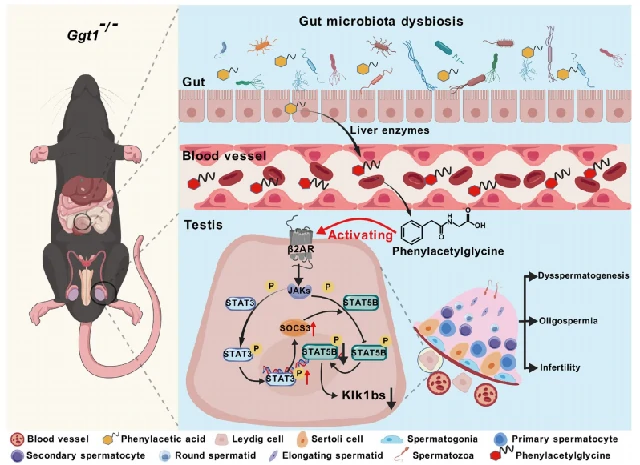
Ggt1deficient male mice develop gut microbiota dysbiosis accompanied by elevated levels of microbialderived phenylacetylglycine (PAGly). Entering the testis via blood circulation, PAGly activates β2adrenergic receptors on Leydig cells. This triggers STAT3 phosphorylation and upregulation of SOCS3 expression, which further suppresses STAT5B phosphorylation and represses transcription of Klk1bs genes, ultimately leading to dysspermatogenesis.
Journal: Microbiome
Author affiliation: Huazhong Agricultural University
DOI:org/10.1186/s40168-026-02401-0
Supported Products
F-TESTO (Free Testosterone) ELISA Kit (RE10005)
Mouse INHB (Inhibin B) ELISA Kit (RE1160M)
Mouse gGT1 (Gamma Glutamyltransferase 1) ELISA Kit (RE3244M)
Abstract:
Background: Male infertility represents a global publichealth concern. Growing evidence links gut microbiota dysbiosis to dysspermatogenesis and reduced fertility. Nevertheless, the molecular mediators and mechanisms by which gut microbiota modulate testicular function remain poorly defined.
Results: In this study, male Ggt1knockout (Ggt1⁻/⁻) mice displayed an infertile phenotype, including reduced numbers of germ cells and Leydig cells, elevated sperm malformation rates, and disturbed reproductive hormone profiles. Metabolomic analyses identified increased levels of gutmicrobiotaderived metabolite phenylacetylglycine (PAGly) in serum and testis tissues of Ggt1⁻/⁻ mice. Invivo injection assays verified that PAGly impairs spermatogenesis. Consistently, blocking PAGly effectively rescued defective spermatogenesis in Ggt1⁻/⁻ mice. Fecal metagenomic and metabolomic profiling revealed that the gut microbiota of Ggt1⁻/⁻ mice drives accumulation of phenylacetic acid, the precursor metabolite of PAGly. Notably, fecal microbiota transplantation from Ggt1⁻/⁻ donors into recipient mice (Ggt1⁻/⁻FMT) recapitulated the infertile phenotype, characterized by decreased germcell counts and higher sperm malformation rates. Mechanistically, combined CUT&Tag and ATACSeq data demonstrated that transcription factor STAT5B binds to regulatory elements near the transcription start site (TSS) of Klk1b genes, confirming direct transcriptional regulation of Klk1b by STAT5B. Specifically, PAGly activates β2adrenergic receptor (β2AR) on testicular Leydig cells, promoting STAT3 phosphorylation, upregulating SOCS3, and inhibiting STAT5B phosphorylation. Reduced levels of transcriptioncompetent phosphorylated STAT5B (pSTAT5B) cause repression of Klk1bs transcription and consequent spermatogenic disorders.
Conclusion: Ggt1 deficiency triggers gut microbiota dysbiosis, which disrupts spermatogenesis through the β2ARSTAT3SOCS3STAT5BKlk1bs signaling cascade. Upon β2AR activation, PAGly enhances STAT3 phosphorylation and SOCS3 expression, thereby repressing pSTAT5Bdependent Klk1bs transcription. This mechanism highlights the critical regulatory role of gutderived metabolites in testicular function and identifies potential intervention targets for gutmicrobiotamediated male infertility.
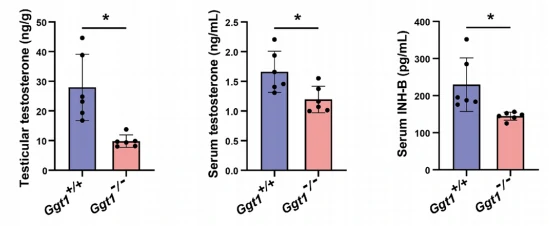
ELISA was used to detect testosterone and inhibinB in serum and testicular tissues.