
 Publish:2026-11-16
 Source:ReedBiotech
 Views:42
Researchers conducting cohort studies may encounter a familiar challenge: sequencing and qPCR reveal correlations between biofluid molecules and disease or developmental phenotypes. The findings are published, but the research project seems to reach a dead end.
01 Correlation does not equal causation
Behind an association between a molecule and a phenotype, is the molecule simply a coincidental biomarker, or does it actually participate in regulating physiological processes? Once differentially expressed molecules have been identified, how can researchers take the next step toward uncovering their biological functions?
A study published in Cell Metabolism on maternal-fetal neurodevelopment provides an excellent example of how to approach this challenge. The researchers first identified candidate biomarkers from complex human milk samples, then used multiple layers of animal experiments to establish a comprehensive evidence chain demonstrating in vivo causality beyond correlation.
This research provides valuable insights for studies in the Developmental Origins of Health and Disease (DOHaD) and the broader field of maternal-fetal research.
02 The Key Scientific Gaps Addressed by This Study
In the field of DOHaD, most research has traditionally focused on pregnancy. The placenta, amniotic fluid, and maternal peripheral blood during pregnancy are among the most commonly investigated biological samples. Breast milk during lactation, however, is generally regarded primarily as a vehicle for delivering nutrients and immune components.
Relatively few studies have systematically investigated whether breast milk can also serve as a signaling medium that reflects maternal physiological status and transmits molecular signals capable of regulating offspring brain development.
Meanwhile, many clinical cohort studies stop at identifying "molecular-phenotype associations," without providing functional evidence of causality in vivo.
Maternal-fetal research faces another particularly challenging issue: the intrauterine environment, maternal caregiving behaviors, and breast milk-derived signals are highly interconnected, making it difficult to distinguish their individual contributions to offspring development.
This study addressed these challenges using a mouse model of maternal stress (postpartum depression-like conditions) and systematically elucidated an intergenerational signaling pathway.
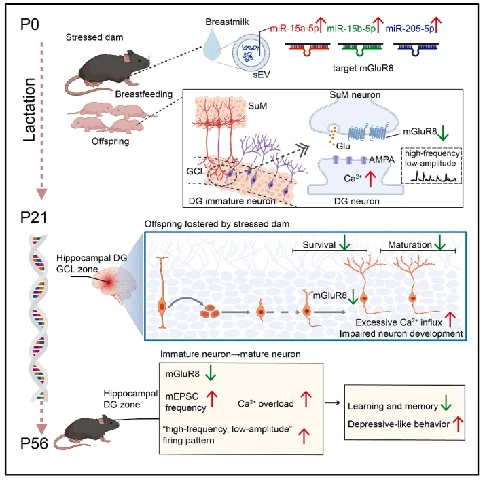
Specifically, stress-induced maternal mice showed enrichment of miR-15a-5p, miR-15b-5p, and miR-205-5p in breast milk-derived small extracellular vesicles (sEVs). These sEVs were transferred to offspring through nursing and subsequently delivered to the brain, where the miRNAs targeted presynaptic mGluR8 in the SuM-DG circuit.
This disrupted the maturation and synaptic integration of newborn hippocampal neurons, ultimately leading to alterations in offspring cognitive and emotional phenotypes, with male offspring showing greater susceptibility.
Through multiple gain-of-function and loss-of-function experiments, the researchers established causal evidence for this pathway in the mouse model.
03 Two Major Experimental Strategies: Building the Evidence Chain from Correlation to Causation
1. Cross-Fostering: Addressing Confounding Variables in Maternal-Fetal Research
Pregnancy and lactation are naturally interconnected, making it difficult to determine whether offspring phenotypes result from prenatal exposure to the intrauterine environment or from postnatal factors such as breastfeeding and maternal caregiving behaviors.
To address this issue, the researchers employed a cross-fostering experimental design, separating the roles of the biological mother (who determines the intrauterine environment) and the foster mother (who provides nursing and maternal care).
Remarkably, even offspring originating from healthy biological mothers exhibited neurological alterations when raised by stress-model foster mothers.
This approach helped isolate the contribution of lactation-related factors from prenatal influences.
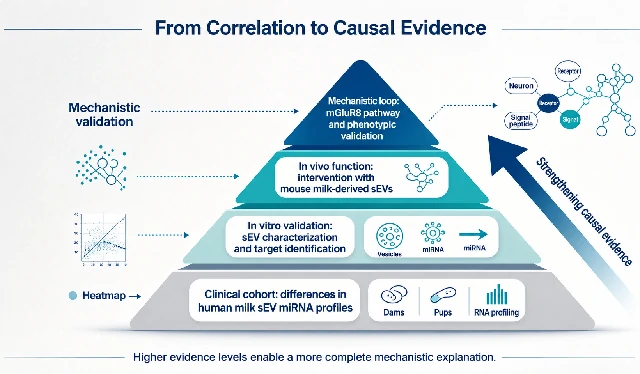
2. A Closed-Loop Research Strategy: From Human Biomarker Discovery to Multidimensional In Vivo Causal Validation
The researchers established a systematic experimental workflow consisting of several key steps:
A. Human sample-based biomarker discovery
Human breast milk samples were collected, and small extracellular vesicles (sEVs) were isolated for small RNA (sRNA) sequencing. Candidate miRNA biomarkers were identified and subsequently validated in human cohort samples using qPCR.
B. In vivo tracing and validation
EV fluorescent reporter mice were used to track the transfer of maternal milk-derived sEVs into offspring and their subsequent delivery to specific brain regions. This provided evidence that the miRNAs originated from maternal milk rather than from upregulated transcription within the offspring themselves.
C. Gain-of-function experiments
The researchers induced targeted overexpression of candidate miRNAs in the mammary glands. This successfully reproduced the neurological phenotypes observed in offspring of stressed mothers, even in otherwise healthy animals.
D. Multiple rescue experiments
Several complementary strategies were employed to strengthen the causal evidence:
Inhibition of overall sEV secretion from the mammary glands.
Neutralization of target miRNAs in breast milk using miRNA sponges.
Restoration of the downstream target gene mGluR8 at the brain circuit level.
Together, these experiments provided converging evidence supporting the proposed signaling pathway.
E. Mechanistic investigation
Single-cell transcriptomic analysis was used to identify key excitatory neurons in the SuM (supramammillary nucleus).
The researchers then combined multiple techniques, including dual-luciferase reporter assays, immunofluorescence, neuronal morphological analysis, brain slice patch-clamp recordings, and in vivo calcium imaging, to investigate the downstream neural circuits and molecular mechanisms.

04 Key Research Insights for the Maternal-Fetal and Neurodevelopmental Fields
1. Expanding the DOHaD research window
DOHaD research should not be restricted to the placenta and amniotic fluid during pregnancy.
Breast milk-derived sEVs during lactation may also serve as important carriers of maternal signals transmitted to offspring.
This opens up new opportunities for investigating how maternal physiological conditions influence offspring development beyond the prenatal period.
2. New perspectives on biomarker research
Breast milk is a non-invasive and relatively accessible biological sample.
The miRNAs encapsulated within sEVs are relatively stable, making them promising candidates for developing biomarkers that reflect maternal physiological status and potentially indicate the risk of abnormal neurodevelopment in offspring.
05 A Balanced Perspective: Limitations and Future Directions
Despite its important findings, this study has several limitations worth considering.
First, human breast milk-derived sEVs were used for biomarker profiling, whereas mouse milk-derived sEVs were used in the in vivo functional experiments. Future studies involving the administration of human milk-derived sEVs in mice will need to carefully address potential challenges associated with cross-species administration.
Therefore, caution is necessary when extrapolating findings from mouse models to humans.
Second, the candidate biomarkers identified in this study require validation in larger human cohorts to establish their clinical predictive value.
Finally, given that individual miRNAs can regulate numerous target genes, this study primarily focused on the mGluR8 signaling pathway. The broader downstream molecular network remains to be explored.
06 Take-Home Message
This study offers an excellent research framework for investigators working with cohort studies.
Identifying a correlation is only the starting point of scientific discovery. There is still substantial work to be done between identifying differentially expressed molecules and establishing a complete causal evidence chain.
Breast milk is more than just a source of nutrition. It may also represent a valuable reservoir of biological signals with profound implications for offspring development.
Disclaimer: This article is an academic interpretation of a high-impact scientific publication and is intended for research and educational purposes only. It does not constitute clinical advice.