
 Publish:2026-10-20
 Source:ReedBiotech
 Views:26
The experiment is completed, and the OD values has appeared. You calculated the CV values , and it's glaring.Your first reaction is "the kit is unstable," and your second reaction is "the experiment has to be redone."
But few people stop to think—CV isn't caused by any single factor; it's the cumulative result of multiple aspects.We break it down: what you can control + what we've done for you—lay it all out, it is fair only.
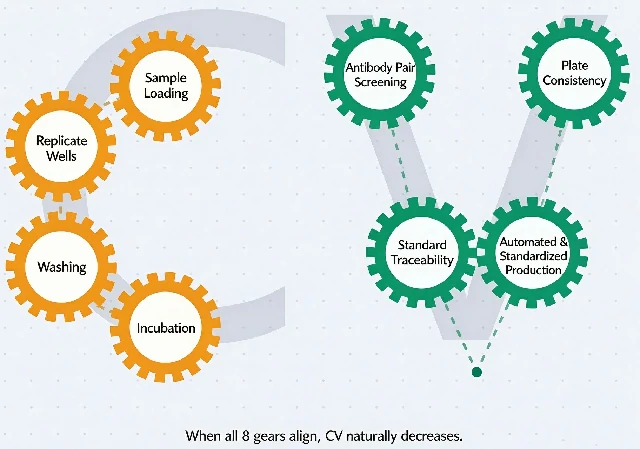
The 4 things you can control
The 4 things below are what the vast majority of customers ask about repeatedly, both pre-sale and after-sale—and they're also the parts you can fully optimize on your own.
① Sample loading
- It is recommended to complete sample loading for the entire plate within 5 minutes.
- From the first well to the last well, a 5-minute difference in incubation point can lead to a 1%–3% difference in OD values.
- Ensuring pipetting accuracy is very important—ELISA itself is a micro-volume experiment, and a single bubble in the pipette tip can cause an OD deviation of 0.05–0.2.
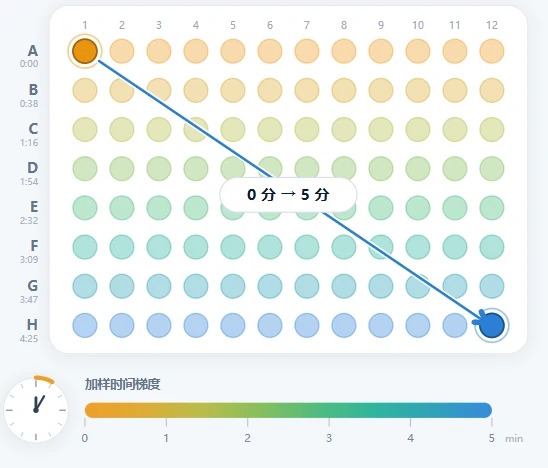
② Replicate wells
- For duplicate sample loading within the same replicate well, try to keep the interval within 30 seconds.
- These 30 seconds may seem insignificant, but in the context of the ELISA enzyme kinetics curve, they are the foundation for "a consistent reaction starting point."
③ Plate washing
- Use 300 μL of wash buffer per well, soak for 30 seconds, and repeat 3 times. When patting dry at the end, pay attention to controlling the patting force—too hard and the strip may fly out, too light and residue will remain. And be sure to avoid rubbing back and forth on the absorbent paper.
- Those who wash plates manually will find that this step contributes more to CV than expected.
④ Plate reading
- After stopping the reaction, it is recommended to complete the reading within 5 minutes. After TMB is stopped, the color will slowly change over time, and wells that are read overtime may show lower OD values.
- One more thing you can do before reading: wipe the bottom of the plate clean—fingerprints, droplets, and dust can each contribute an OD deviation of 0.005–0.01.
Part II: The 4 things we've done for you
The 4 things below are what you can't see at the experiment table but that determine the lower limit of CV at every step—and they're also our core responsibility as a manufacturer.
⑤ Antibody pair screening
Whether a kit is good or not, the antibody pair matters a great deal. We rigorously select monoclonal antibody pairs to reduce cross-reactivity from the source.
⑥ Uniformity of the Enzyme-Linked Plate
The "inner strength" of the plate lies in its uniform adsorption. Our enzyme-linked plates have a CV (Coefficient of Variation) of less than 3% within the plate. After each batch arrives at the factory, batch verification will be conducted again. Plates with uneven adsorption will be directly eliminated.
⑦ Standard traceability
The "inner strength" of the plate lies in its uniform adsorption. The CV (coefficient of variation) within our enzyme-labeled plate is less than 3%. After each batch arrives at the factory, batch verification will be conducted again. Any plates with uneven adsorption will be directly eliminated.
⑧ Standardized automated production
Whether the calibration is stable or not, the standard substance is the key. For each batch of our standard substances, we conduct activity calibration and stability tests to prevent variations between batches.
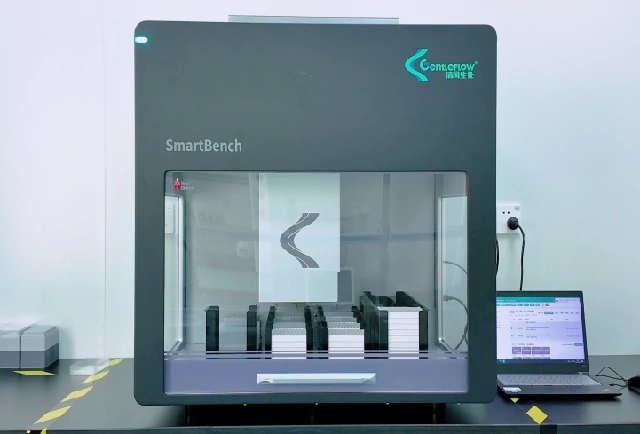
The CV is not a numerical value of the product, nor is it a numerical figure of the operation. It is the accumulation of various events. If you do well in 4 items and we will cover for the remaining 4 items - naturally, the CV will fall within 15% or less.
Do everything well that you can do, and hand over what can be entrusted to the manufacturer.