
 Publish:2026-10-01
 Source:ReedBiotech
 Views:70
Title:Failed Mucosal Allostasis Distinguishes Murine IgG-From IgE-Mediated Recurrent Severe Anaphylaxis
Allergy——Impact Factor (IF): 11.3
Affiliation: Bursa Uludağ University
DOI: org/10.1111/all.70503
Featured Products
- HA (Histamine) ELISA Kit — RE10142
- Mouse PAF (Platelet Activating Factor) ELISA Kit — RE3123M
Abstract
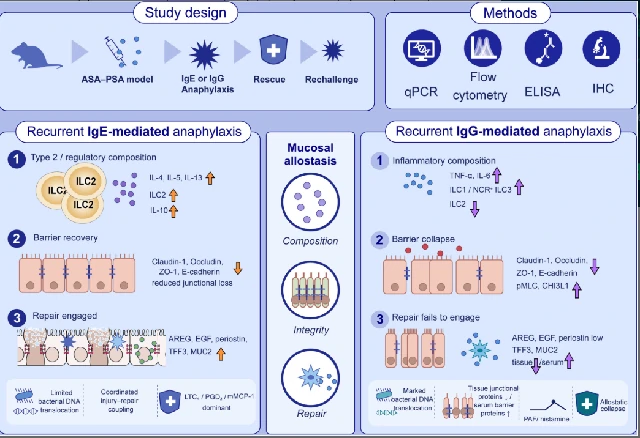
Classical theories indicate that anaphylaxis is primarily mediated by the IgE–FcεRI signaling pathway, while some severe allergic reactions can also activate the IgG–FcγR pathway. However, the effects of repeated activation of these pathways on mucosal barrier integrity and epithelial repair capacity remain unclear.
Based on this, the present study proposes that mucosal homeostasis is coordinately regulated by immune components, structural integrity, and tissue repair capacity, thereby maintaining mucosal functional stability during severe allergic reactions.
The authors define this adaptive state as mucosal allostasis and further investigate the differences between the IgE- and IgG-mediated allergic pathways within this mucosal regulatory system.
An active-passive combined sensitization model (ASA-PSA) was employed to establish IgE- and IgG-mediated allergic reaction models in BALB/c mice. Acute and recurrent severe allergic reactions were induced, followed by standardized matching-antigen rechallenge through pharmacological intervention.
Lung, small intestine, colon, and serum samples were comprehensively collected for multidimensional analyses, including cytokines, inflammatory mediators, mucosal tight-junction proteins, tissue repair-related molecules, and bacterial 16S rDNA. Flow cytometry and immunohistochemistry were also performed to characterize the distribution of mucosal innate lymphoid cell (ILC) subsets and the structural integrity of tight junctions.
The results showed that there was no significant difference in overall clinical severity between IgE- and IgG-mediated allergic reactions. However, marked differences were observed in the mucosal injury and regulatory responses associated with the two pathways.
In recurrent IgE-mediated allergic reactions, the normal expression of tight-junction proteins was effectively maintained, while a mucosal injury repair program involving AREG, EGF, periostin, TFF3, and MUC2 was activated.
In contrast, recurrent IgG-mediated allergic reactions resulted in a profound disruption and collapse of this mucosal repair system. The expression of tight-junction proteins and E-cadherin was significantly downregulated in tissues, while the corresponding protein levels in serum were compensatorily elevated.
In areas of severe mucosal injury, activation of tissue repair-related mediators was impaired, accompanied by a 48-fold increase in bacterial DNA translocation. Meanwhile, the mucosal immune landscape underwent substantial remodeling, shifting from a state dominated by type 2 and regulatory immunity toward a pro-inflammatory immune profile. Innate lymphoid cell subsets were also reprogrammed, characterized by extensive conversion of ILC2 cells toward ILC1 and NCR⁺ ILC3 subsets.
Conclusion
In conclusion, recurrent severe IgE- and IgG-mediated allergic reactions can induce two mechanistically distinct mucosal allostatic phenotypes.
Repeated IgG-mediated allergic reactions trigger a collapse of mucosal allostasis, resulting in structural mucosal damage and the uncoupling of tissue repair functions.
These findings suggest that the coupled pathway linking barrier integrity and tissue injury repair may represent a potential precision therapeutic target for refractory and recurrent allergic reactions.
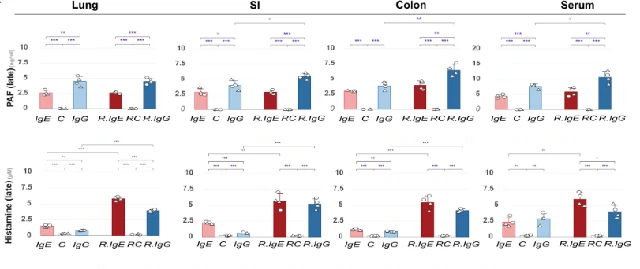
ELISA was used to measure the concentrations of PAF and histamine in the lungs, small intestine, colon, and serum of each group at the terminal stage.