
 Publish:2026-09-14
 Source:ReedBiotech
 Views:271
The field of Alzheimer’s disease (AD) diagnostics has recently reached two major milestones—globally and in China—reshaping both neuroscience research and the clinical landscape.
On one hand, the Elecsys pTau217 blood test, jointly developed by Roche and Lilly, has received FDA approval, becoming the world’s first single-biomarker blood-based diagnostic test for AD. This challenges the long-standing assumption that AD diagnosis requires multiple biomarkers to be measured simultaneously.
On the other hand, three domestically developed blood-based protein detection products for AD have received centralized approval in China, driven by the Beijing Medical Products Administration. This marks an important transition of AD blood testing in China from research applications toward clinical commercialization.

Together, these two developments are not only reshaping the clinical diagnosis and management of AD, but are also directly accelerating an upgrade of the AD research biomarker landscape.
In current research on neurodegenerative diseases—including basic research, disease-model validation, mechanism studies, and drug screening and evaluation—pTau217 has evolved from a routine research target into a widely recognized core biomarker for AD research.
From a Supporting Research Biomarker to a Clinical Benchmark: The Rise of pTau217
For many years, AD diagnosis and research have largely relied on the combination of Aβ amyloid proteins and pTau181.
The conventional research rationale was that a single blood biomarker might lack sufficient specificity. Therefore, multiple biomarkers were often considered necessary to minimize interference and ensure reliable interpretation of the results.
This also made early-stage AD research relatively complicated, involving cumbersome experimental workflows, complex data interpretation, and challenges with reproducibility.
The recent FDA approval of pTau217 as a standalone biomarker for diagnosis provides important technical evidence that blood pTau217 levels can accurately reflect cerebral amyloid pathology.
Importantly, this conclusion is not simply based on a company's technical claims. It is supported by evidence from clinical and biomedical research.
A large meta-analysis of blood-based biomarkers for AD published in The Lancet Neurology in 2025 included 113 studies involving nearly 30,000 participants across 24 countries. The analysis identified pTau217 as having the strongest overall diagnostic performance among currently available blood-based AD biomarkers [2].
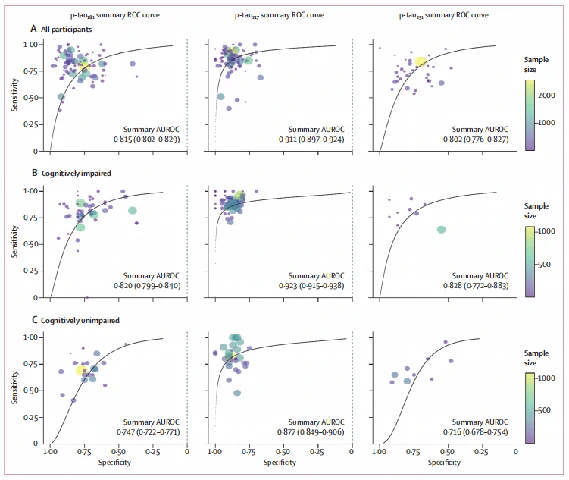
Summary ROC curves for p-tau181, p-tau217, and p-tau231. Each data point represents the sensitivity and specificity reported by an individual study. The size and color of each point represent the sample size of the corresponding study.
Image source: Therriault J, et al. “Blood phosphorylated tau for the diagnosis of Alzheimer's disease: a systematic review and meta-analysis.” The Lancet Neurology.
Compared with Other AD Targets, What Makes pTau217 Stand Out?
Aβ (Aβ1-40 / Aβ1-42): A Pathological Initiator, but with Limited Clinical Specificity
Aβ deposition is considered one of the key pathological events in AD and is highly relevant to studies focusing on disease mechanisms, pathological origins, and early-stage disease models.
However, one of the major limitations of Aβ is its relatively limited specificity.
Normal aging, mild brain injury, and other forms of neuroinflammation may also cause fluctuations in Aβ levels. As a result, Aβ alone may not reliably distinguish normal cognitive decline from pathological AD.
This limits its ability to serve as a standalone biomarker for precise diagnosis or quantitative drug efficacy evaluation.
Multiple comparative studies have reported relatively higher rates of misclassification and false-positive results with single Aβ blood biomarkers, limiting their value as independent diagnostic markers. Aβ therefore remains highly valuable for studying pathological mechanisms, but is less suitable as a standalone biomarker for early precise screening and quantitative assessment of therapeutic response.
pTau181: A Classic Biomarker with Limitations in Early-Stage AD Research
As one of the most established Tau isoforms used in AD research, pTau181 benefits from a mature technical platform and extensive supporting literature.
It is well suited to pathological studies, particularly in patients with established or more advanced AD.
However, its major limitation is its relatively lower sensitivity during the earliest stages of disease.
Before patients develop obvious cognitive impairment, changes in pTau181 may be relatively subtle, making it more difficult to capture early pathological changes.
This limits its application in research focused on early prediction and early intervention in AD.
Research data indicate that pTau181 generally shows lower AUC values than pTau217 for identifying early AD pathology, highlighting its limitations for early-stage screening [3].
pTau217: A Leading Target for Early-Stage AD Research
Compared with the two biomarkers above, pTau217 offers distinct advantages in both research and clinical applications. Quantitative evidence from multiple high-impact studies further supports its potential:
1.High Specificity and Excellent Disease Discrimination
pTau217 can effectively distinguish AD from other neurodegenerative diseases, including frontotemporal dementia, dementia with Lewy bodies, and Parkinson’s disease, helping reduce interference from non-AD pathology.
Multiple studies have demonstrated that pTau217 provides superior disease-discriminating performance compared with pTau181 and can better differentiate AD-related Tau abnormalities from those associated with other pathological processes.
2.Extremely High Sensitivity in Early Disease Stages
Significant differences in pTau217 levels can be detected during the MCI (mild cognitive impairment) stage and even during the asymptomatic pathological phase.
This makes pTau217 highly relevant to research on early disease prediction and pathological progression, and potentially enables risk assessment years before the onset of clinically apparent cognitive impairment.
As a result, pTau217 has emerged as one of the most promising blood-based biomarkers for non-invasive, early-stage AD screening and research.
3. Strong Compatibility with Large-Scale Cohort Studies and Clinical Translation
A multicenter Chinese cohort study demonstrated that, in a head-to-head comparison involving 431 participants from ten memory clinics in China, a high-performance pTau217 assay achieved an AUC of up to 0.93 for identifying cerebral Aβ amyloid pathology.
Its performance remained stable across both MCI and dementia subgroups, making pTau217 particularly suitable for the quantitative requirements of large-scale cohort studies and translational research [5].

Figure: Performance of pTau217 in identifying cerebral amyloid pathology in a multicenter Chinese cohort.
AD Research Has Officially Entered the Era of Single-Target Deep Exploration
For a long time, AD research has often relied on multiple-biomarker combinations, sometimes resulting in generalized mechanistic interpretations and relatively low data specificity.
Many studies have traditionally focused on combinations such as Aβ and pTau181.
With the advancement of pTau217 as a standalone biomarker, together with the commercialization of domestically developed AD blood-based testing technologies in China, AD research is moving toward a new paradigm:
From broad multi-target profiling to focused, high-resolution investigation of key individual biomarkers.
For researchers working on AD mechanisms, disease models, biomarker validation, drug screening, or therapeutic efficacy evaluation, pTau217 is rapidly becoming a critical target to watch.
Reference
[1] Therriault J, Brum W, Trudel L et al. Blood phosphorylated tau for the diagnosis of Alzheimer's disease: a systematic review and meta-analysis. The Lancet Neurology, 24, 740-752
[2] Janelidze S, Bali D, Ashton NJ, et al. Head-to-head comparison of 10 plasma phospho-tau assays in prodromal Alzheimer's disease. Brain. 2023;146(4):1592-1601. doi:10.1093/brain/awac333
[3] Janelidze S, Ashton NJ, Orduña Dolado A, et al. A comparison of p-tau assays for the specificity to detect tau changes in Alzheimer's disease. Alzheimer's Dement. 2025; 21:e70208. https://doi.org/10.1002/alz.70208
[4]Xinyi Lv, Kaiyuan Shen, Qianhua Zhao, et al.Head-to-head comparison of plasma biomarker assays across platforms for amyloid pathology in a multicen