
 Publish:2026-08-27
 Source:ReedBiotech
 Views:534
——Nature Research | Engineered Probiotic GIFT Achieves Closed-Loop Glycaemic Control in Diabetes, with Efficacy Comparable to Semaglutide and an Improved Safety Profile
Title: Glucose-responsive probiotics for glycaemic modulation in mice and monkeys
DOI: 10.1038/s41586-026-10909-6
1. The Dilemma: Effective Drugs Aren’t Always Convenient, and Convenient Approaches Aren’t Always Safe
GLP-1 receptor agonists have been one of the biggest breakthroughs in diabetes treatment over the past decade. However, most GLP-1 therapies are administered by subcutaneous injection. Although oral formulations are now available, their absorption is extremely low and their use is subject to strict dosing conditions. Long-term treatment may also be associated with hypersensitivity reactions, thyroid-related safety concerns, hypoglycaemia when combined with insulin, and loss of lean body mass.
Genetically engineered mammalian “designer cells” offer a theoretically more precise alternative: cells can be programmed to secrete therapeutic proteins on demand inside the body. However, this approach requires cell transplantation. Long-term implantation introduces major barriers to clinical translation, including immune rejection, difficulty in removing the cells, and potential tumorigenic risks.
This raises a fundamental question:
Is it possible to develop an orally administered therapy that can sense blood glucose, secrete GLP-1 on demand, and eliminate the need for cell transplantation?
A study from the team of Hai-Feng Ye at East China Normal University, published in Nature, provides a promising answer. The researchers engineered the entire system into an orally administered probiotic bacterium, which they named GIFT (glucose-sensing and functional response probiotic).
2. Design: Installing a “Blood Glucose Switch” into Bacteria
The chassis of GIFT is the clinically used probiotic strain Escherichia coli Nissle 1917 (EcN). The glucose-sensing switch was derived from the glucose metabolic regulatory network of Pseudomonas putida, with the transcription factor HexR serving as the core component.
- In the absence of glucose, HexR binds to the promoter and represses downstream gene expression.
- When glucose becomes available, it is metabolized through the Entner–Doudoroff pathway to produce KDPG. KDPG binds to HexR, causing HexR to dissociate from the DNA.
- The “lock” is therefore released, allowing transcription to begin.
By introducing this glucose-responsive switch into EcN and connecting it to a GLP-1 expression cassette, the researchers created a complete glucose-sensing and response feedback loop.
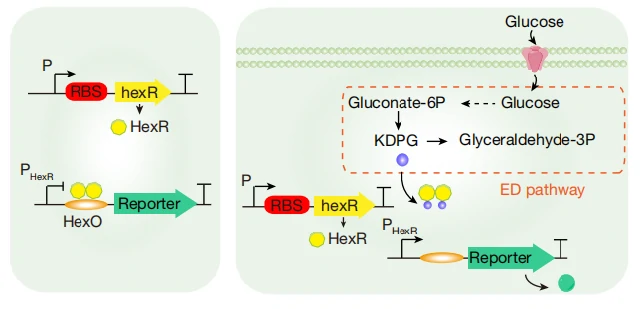
Schematic illustration of the HexR-based glucose sensor design. Adapted from Figure 1b of the original paper.
3. Mice: Blood Glucose Returned to the Normal Range After 30 Days
In the study, genetically diabetic db/db mice received oral GIFT at 10⁹ CFU per day for 30 consecutive days.
Fasting blood glucose progressively decreased and eventually returned to the normal range. Glucose tolerance (IGTT) and insulin tolerance (ITT) also improved, accompanied by a reduction in HbA1c.
Serum GLP-1 concentrations peaked approximately 2–4 hours after administration and subsequently decreased as blood glucose levels declined, demonstrating that the “sensing–response” closed loop was functioning in vivo.
GLP-1 concentrations in portal blood were significantly higher than those in peripheral blood, suggesting that, in addition to the classical endocrine pathway, the gut–portal–neural axis may also contribute to the therapeutic effect. Liver glycogen levels increased, while the epididymal fat coefficient decreased.
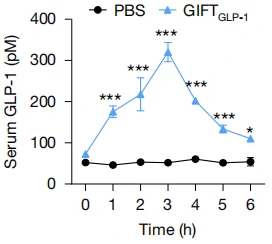
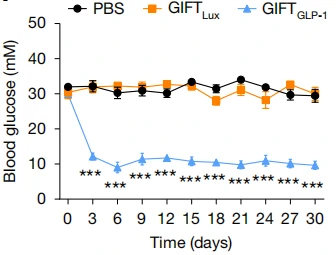
Serum GLP-1 levels following oral administration of GIFT-GLP-1 (left); fasting blood glucose measured every three days (right). Daily oral administration of GIFT-GLP-1 (10⁹ CFU) for 30 days reduced fasting blood glucose to the normal range, whereas the PBS and GIFT-Lux control groups remained hyperglycaemic. Adapted from Figures 2e and 2i of the original paper.
Beyond Glycaemic Control: A Broader Metabolic Effect
After 30 days of treatment, body weight, fat mass, serum triglycerides (TG), and total cholesterol (T-CHO) were all reduced.
Indirect calorimetry showed decreased food intake, increased energy expenditure, and a lower respiratory exchange ratio (RER), indicating a metabolic shift from glucose utilisation toward greater lipid utilisation.
The treatment also alleviated hepatic steatosis and inflammation and improved oxidative stress. Serum creatinine, BUN, and urinary protein levels decreased, accompanied by improvements in glomerular pathology.
Meanwhile, the beneficial gut bacterium Faecalibacterium prausnitzii was significantly enriched.
The researchers also simulated postprandial glucose fluctuations using cola and chocolate. GIFT effectively suppressed postprandial glucose peaks, and its response remained reproducible following two consecutive glucose challenges.
The therapeutic effect was also reproduced in db/db mice fed a low-sugar diet and in a non-genetic T2D model induced by a high-fat diet combined with streptozotocin (STZ).
4. Cynomolgus Monkeys: From Rodents to Primates
In spontaneously diabetic cynomolgus monkeys, a single oral dose of GIFT (2 × 10¹¹ CFU/kg) rapidly increased GLP-1 and insulin levels, with glucose-lowering effects lasting approximately three days.
When administration was changed to once every three days for five weeks, random blood glucose, OGTT results, and insulin resistance indices all improved.
Importantly, body weight remained stable, and no abnormalities were observed in routine blood counts or liver and kidney function.
From rodents to primates, the “sensing–response” mechanism was successfully validated across species—an essential step for translating metabolic therapies toward clinical applications.
5. Head-to-Head Comparison: GIFT vs. Semaglutide
|
Parameter |
Semaglutide (Injection) |
GIFT-GLP-1 (Oral) |
|
Serum GLP-1 peak concentration |
6,000–12,000 pM |
40–250 pM |
|
Glycaemic efficacy |
Significant |
Comparable |
|
IgE / IL-6 / IFN-β (hypersensitivity-related) |
Increased |
No significant change |
|
Calcitonin (thyroid stress marker) |
Increased |
No significant change |
|
ALT / AST (hepatic stress markers) |
Increased |
No significant change |
|
Hypoglycaemia risk with insulin glargine |
Significantly increased |
No increase |
|
Conditioned taste aversion |
Observed |
Not observed |
|
Lean body mass |
Tended to decrease |
Maintained or slightly increased |
One of the most striking findings is that GIFT achieved comparable glycaemic efficacy at approximately 1/50 of the peak GLP-1 concentration observed with injectable semaglutide.
The peak GLP-1 concentration generated by GIFT was only around one-fiftieth of that associated with injectable semaglutide, yet the glucose-lowering effect was comparable. This suggests that local delivery through the intestinal lumen–portal circulation may provide greater efficiency than systemic administration, while potentially reducing the risks associated with supraphysiological drug exposure.
The “Safety Dividend” of Glucose Responsiveness
When combined with basal insulin, semaglutide significantly increased hypoglycaemic events, whereas GIFT did not.
The underlying principle is straightforward:
GIFT “works” when blood glucose is high and “switches off” when glucose returns to normal.
This is precisely where the clinical value of a closed-loop therapeutic system lies.
6. Daily and Repeated Administration: Will the Immune System Respond?
One of the biggest differences between a live biotherapeutic and a conventional tablet is that the former may need to be administered repeatedly over an extended period.
This raises an important question: could repeated exposure to the engineered bacteria and therapeutic protein trigger an adaptive immune response?
If neutralising antibodies were generated, reduced efficacy would be only the first concern; immune-mediated pathology could represent a more serious risk.
Therefore, immunogenicity following repeated administration is a critical component of safety evaluation for live biotherapeutics.
The researchers treated db/db mice orally for one month and measured serum IgG1 and IgG2c, using three groups:
- PBS control
- GIFT-Lux, carrying only the reporter gene
- GIFT-GLP-1, the complete therapeutic strain
The results showed that one month of repeated administration did not induce a significant adaptive immune response against either the bacterial chassis or the GLP-1 therapeutic protein.
Complete blood counts and pro-inflammatory cytokines also showed no abnormal changes. Similarly, long-term administration in cynomolgus monkeys did not result in leukocytosis.
Together with the acute safety data—including the absence of hypersensitivity, elevated calcitonin, and hepatic stress—these findings provide encouraging evidence that this type of orally administered live biotherapeutic may be suitable for repeated dosing.
ELISA Kits Used in the Study
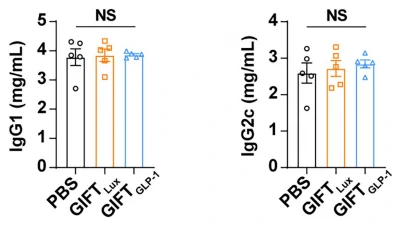
The IgG1 and IgG2c measurements reported in this study were performed using ELISA kits from Reed Biotech:
· Mouse IgG1 ELISA Kit (RE2807M)
· Mouse IgG2c ELISA Kit (RE3335M)
Serum IgG1 and IgG2c levels following one month of repeated administration showed no detectable adaptive immune response against either the bacterial chassis or the GLP-1 therapeutic protein. Adapted from Extended Data Figure 10t,u of the original paper.
7. A Cautious Perspective: Limitations of the Study
The study also has several limitations that should be considered.
Some endpoints were evaluated using relatively small sample sizes. For example, the gut microbiota analysis included only five animals per group, which may limit the ability to capture inter-individual variation.
The 30-day treatment period did not cover the complete 40–45-day lifespan of mouse erythrocytes, meaning that changes in HbA1c should be interpreted with caution.
In addition, the cynomolgus monkey experiments did not include a bacterial chassis control group.
Nevertheless, beyond these limitations, the most important value of GIFT may lie in its platform potential.
The therapeutic module can potentially be replaced—for example, GLP-1 could be substituted with other therapeutic peptides. The bacterial chassis could also potentially be changed, while the “sensing–response” paradigm could be extended to other metabolic diseases that require closed-loop regulation.
For the fields of synthetic biology and metabolic disease therapy, GIFT represents more than just a new therapeutic molecule.
It represents a new therapeutic platform: an orally administered, engineered living system capable of sensing physiological signals and responding with precisely regulated drug delivery.