
 Publish:2026-05-26
 Source:ReedBiotech
 Views:1090
Recently, a review titled "Navigating the Clinical Progress of Antibody-Drug Conjugates" was published in Cell, summarizing the breakthroughs and future directions of antibody-drug conjugates (ADCs). The article emphasizes that Conjugates technology and linker chemistry are fundamental to determining ADC uniformity, stability, drug release efficiency, and therapeutic index. With multiple ADC drugs approved globally, next-generation designs—including bispecificity, dual payloads, non-internalizing formats, and tumor microenvironment activation—are rapidly advancing. Conjugation technology has moved from behind-the-scenes support to become a focal point in both industry and clinical practice, serving as a key gateway to understanding innovation in next-generation precision therapeutics.
Conjugation technology is not a single chemical reaction, but rather a technique that precisely "assembles" antibodies, small molecules, proteins, nucleic acids, and other components into integrated therapeutics through three core capabilities: directed linking, controlled release, and structural uniformity. It overcomes the key barriers of "targeting carrier + active payload + smart linker," becoming the foundational technology for next-generation therapies such as ADCs, radioisotope-conjugates drugs (RDCs), antibody-oligonucleotide conjugates (AOCs), and immune-stimulating conjugates (ISACs).
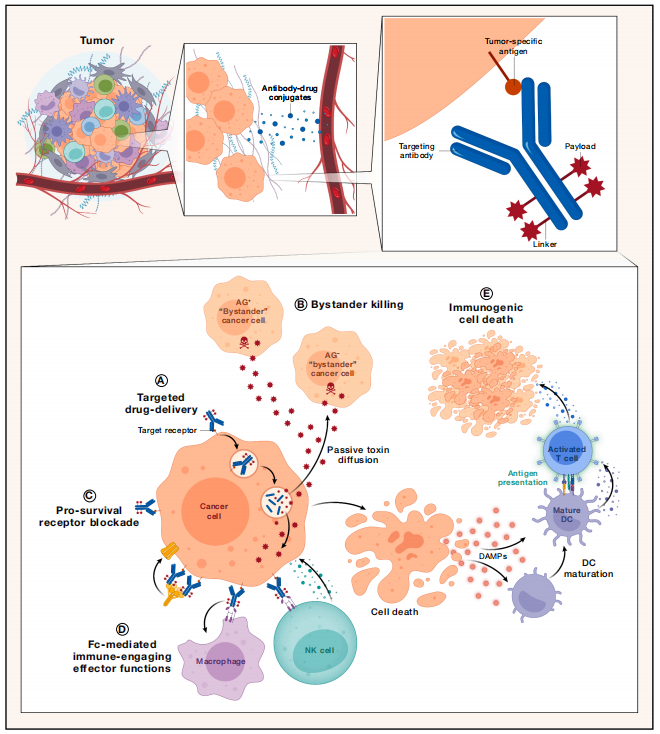
The mechanism of action of ADC, original link: https://www.cell.com/cell/fulltext/S0092-8674(26)00451-4
Conjugation Technology: The "Essential Craft" Determining the Success of Conjugated Drugs
Conjugated drugs are referred to as "trinity" drugs (antibody/vehicle + linker + payload). The Conjugation technology determines three key indicators:
Homogeneity: Whether the distribution of the drug-antibody ratio (DAR) is concentrated and the batch stability is reliable
Stability: Not dissociating prematurely in the blood and precise release in the tumor microenvironment
Therapeutic index: Maximizing efficacy and minimizing systemic toxicity
The shift from random coupling to site-specific Conjugation is the core turning point for ADCs to move from low efficiency and high toxicity to success. The early random Conjugation(random modification of lysine/cysteine) led to a wide distribution of DAR, unstable circulation, off-target effects, and toxicity; the new generation of site-specific Conjugation achieves uniform products, controllable DAR, higher stability, and better pharmacokinetics.
Evolution of conjugation technology: From "coarse random" to "precise programmable"
Random conjugation: Randomly connect using lysine amino groups on antibody surfaces or cysteine sulfhydryl groups after reduction of inter-chain disulfide bonds, such as Mylotarg (Gemtuzumab Ozogamicin), Kadcyla (T-DM1), but the products are heterogeneous, DAR is not uniform, prone to reverse Michael reaction decoupling and have a narrow therapeutic window.
Semi-Site-Specific Conjugation: Intermolecular disulfide bond targeted reduction and re-bridging. Its advantage lies in the fact that DAR is concentrated at 3–4/7–8, along with improved batch-to-batch consistency.
Site-specific conjugation:Core technologies include engineered cysteine (ThioMab), non-natural amino acids (pAcF, etc.), enzymatic conjugation (transglutaminase TGase, sorting enzymes), glycosylation remodeling and glycosylation conjugation, bioorthogonal click chemistry (IEDDA, azide-alkyne cycloaddition). DAR is precisely controllable (2/4/8), the structure is completely uniform, plasma stability is improved,toxic side effects are lower,and therapeutic efficacy is predictable.
Two core elements: linker chemistry + Conjugation sites
The linker acts as the "smart switch" for conjugated drugs, and is mainly divided into two types: cleavable and non-cleavable. The cleavable linkers include enzymatic cleavage (valine-citric acid Val-Cit, glycine-glycine-phenylalanine-glycine GGFG), acid cleavage (hydrazone bond), and glutathione cleavage (disulfide bond), which can precisely release the payload within tumors and generate a strong bystander effect, making them more suitable for solid tumors; the non-cleavable linkers, such as the SMCC thioether bond (representing drug Kadcyla), have extremely high plasma stability but no bystander effect and rely on high antigen expression.
The Conjugation sites determine the "character" of the drug. The lysine Conjugation reaction is simple but has many sites and complex products. The cysteine Conjugation is the current standard scheme in the industrial field, with balanced overall performance. The glycosylation Conjugation does not interfere with the antigen binding region. The engineered amino acids and enzymatic Conjugation points can achieve true homogeneity, becoming the standard for the next-generation Conjugation technology.
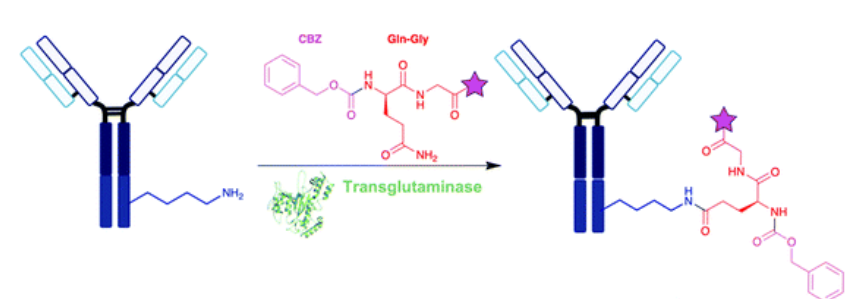
Transglutaminase-based antibody conjugation strategy
[Haque,M.et.al,Site-selective lysine conjugation methods and applications towards antibody–drug conjugates,Chem. Commun.]
Outlook: The 5 Major Breakthrough Directions of conjugation Technology
1. High-loading conjugation: Topoisomerase I inhibitor-based ADCs can stably achieve a DAR of 8 while maintaining potent efficacy even in HER2-low and heterogeneous tumors.
2. Dual-load/Multi-load Conjugation : The same antibody precisely connects two different types of loading mechanisms (such as Top1 inhibitor + microtubule inhibitor/immune agonist), achieving synergistic killing and overcoming drug resistance.
3. Bispecific conjugation (BsADC): A single molecule simultaneously targets two antigens or epitopes, improving tumor selectivity, reducing off-target effects, enhancing internalization, and significantly expanding the range of druggable targets.
4. Non-internalizing conjugation (TME-activated type):** Relies on tumor microenvironment proteases to release the payload directly extracellularly, independent of antigen internalization.
5. Bioorthogonal "click-and-release" conjugation: Externally triggered, precision drug release with spatiotemporal control, further enhancing safety.
Site-specific conjugation reduces toxicity, while high payload capacity and the bystander effect help overcome drug resistance. Together, these advances extend the indications of conjugated drugs from hematologic malignancies to a wide range of solid tumors, while their strong scalability empowers the development of diverse classes of conjugated therapeutics
Conjugation Technology = The "Universal Chassis" for Precision Medicine
From random to site-specific, from single-payload to multi-payload, from internalization-dependent to TME-activated — every iteration of conjugation technology has driven the birth of next-generation therapeutics. No longer limited to ADCs, conjugation is now becoming the common underlying technology for RDCs, AOCs, ISACs, DACs (degrader-antibody conjugates), and beyond.Looking ahead, with advances in "site-specific precision, intelligent linkers, diversified payloads, and scalable manufacturing," conjugation technology will continue to reshape the landscape of precision medicine and serve as the core engine of biopharmaceutical innovation.