
 Publish:2026-11-23
 Source:ReedBiotech
 Views:17
If you’re used to measuring protein biomarkers, Sandwich ELISA probably feels like second nature. It’s intuitive, straightforward, and easy to follow.
But when you start working with small-molecule targets, you open the kit manual and discover that it uses Competitive ELISA instead. Suddenly, things get confusing.
Some researchers even skip the instructions and try to run the assay using a sandwich format out of habit.
So, why can’t small molecules be detected using Sandwich ELISA? The answer is simple: it’s not that manufacturers don’t want to develop a sandwich assay—it’s that the principle itself often makes it impossible.

The Fundamental Reason: Molecular Size Determines the Number of Available Epitopes
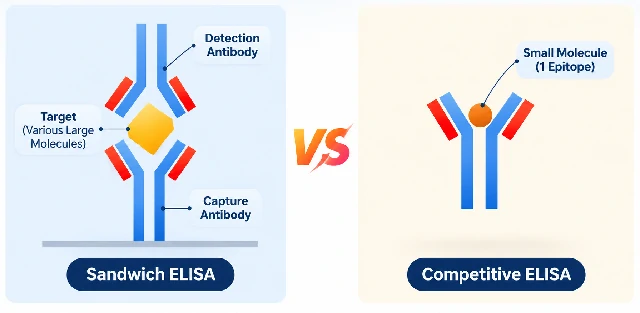
Sandwich ELISA requires one essential condition: the target antigen must have at least two distinct, non-overlapping epitopes that can be simultaneously recognized by two antibodies.
Large protein molecules, typically with molecular weights of tens of kDa or more, often have multiple accessible epitopes. One antibody binds to one region of the protein, while another recognizes a different region. Because the two antibodies can bind simultaneously without interfering with each other, a sandwich structure can form.
Small-molecule targets, however, are generally less than 1,000 Da. Examples include taurine, 4-HNE, hormones, and certain small-molecule neurotransmitters.
These molecules are simply too small to accommodate two antibodies binding simultaneously to separate sites. Even if a small molecule can be recognized by a specific antibody, it generally cannot provide two independent binding sites for a capture antibody and a detection antibody.
Once one antibody binds, there is essentially no room for a second antibody to bind the same molecule.
No room for two antibodies means no sandwich.
If You Can’t Form a Sandwich, Switch to Competition
Instead of trying to sandwich the target, Competitive ELISA uses a different strategy: a limited amount of antibody competes between the target in the sample and the target immobilized on the plate.
The microplate is pre-coated with a small-molecule–carrier protein conjugate. Since small molecules cannot be efficiently immobilized directly onto a 96-well plate, they are usually conjugated to larger carrier proteins, such as BSA or OVA, to facilitate coating onto the solid phase.
The assay contains two forms of antigen:
- Solid-phase antigen: Small-molecule–carrier protein conjugates immobilized on the microplate.
- Liquid-phase antigen: The target small molecule present in the sample.
When the specific antibody is added, the target in the sample competes with the plate-bound antigen for antibody binding.
How does the competition work?
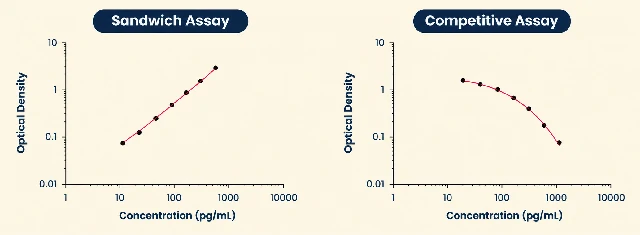
- Higher target concentration in the sample: More antibodies are occupied by the target in the sample, leaving fewer antibodies available to bind to the plate-coated antigen → weaker color development → lower OD signal.
- Lower target concentration in the sample: More antibodies are available to bind to the plate-coated antigen → stronger color development → higher OD signal.
- The key takeaway: Competitive ELISA has an inverse relationship between target concentration and OD signal.
The higher the target concentration, the lower the OD value. This is exactly the opposite of the typical Sandwich ELISA response.
This is one of the most common mistakes beginners make when working with competitive ELISA—they assume that a higher concentration must produce a stronger signal.
Small-Molecule Competitive ELISA: Frequently Asked Questions
Q1. Is the zero well in Competitive ELISA the same as the blank well in Sandwich ELISA?
No. They serve different purposes.In Sandwich ELISA, the blank well is primarily used to account for background signal and correct the measurement.
In Competitive ELISA, the zero standard (or zero well) represents the condition with no target analyte present. It therefore produces the maximum antibody binding to the plate and typically corresponds to the highest signal on the standard curve.
Q2. Can samples that have undergone repeated freeze–thaw cycles still be used to detect small molecules?
Repeated freeze–thaw cycles should be avoided whenever possible.
They may alter the distribution of small molecules between free and protein-bound forms. In addition, some small molecules may degrade during repeated freeze–thawing, potentially leading to inconsistent or variable results.
We recommend aliquoting samples immediately after collection and minimizing repeated freeze–thaw cycles.
Q3. Which is better, Sandwich ELISA or Competitive ELISA?
There is no universally superior method. The best assay format is the one that matches the characteristics of your target.
- Sandwich ELISA: Generally preferred for larger protein targets with multiple accessible epitopes. It often offers high sensitivity and good assay specificity.
- Competitive ELISA: Commonly used for small molecules that cannot accommodate simultaneous binding by two antibodies.
Understanding your target’s molecular characteristics is the first step toward choosing the right ELISA format—and getting reliable results.