
 Publish:2026-07-31
 Source:ReedBiotech
 Views:488
A study published in Nature Cancer revealed that the neurotransmitter GABA can “reprogram” myeloid-derived suppressor cells (MDSCs) in females, creating an immunosuppressive environment that suppresses anti-tumor immunity. Blocking this pathway significantly prolonged survival only in female mice.
Glioblastoma (GBM) is the most common and aggressive primary malignant brain tumor in adults, with a median survival time of only approximately 18–20 months. More challenging is that immunotherapies, which have shown remarkable success in cancers such as melanoma and lung cancer, have repeatedly failed in GBM. One major reason is that the GBM tumor microenvironment contains large numbers of myeloid cells with strong immune-suppressive functions.
This study focused on an unexpected player: γ-aminobutyric acid (GABA), the most abundant inhibitory neurotransmitter in the brain. The results showed that in females, GABA does more than act as a neuronal “brake”—it also applies an immune “brake” to anti-tumor responses.
01. Meet the “Accomplice”: MDSCs and Their Two Subpopulations
Previous work from this research group identified a critical sex-specific difference in GBM immunity:Male tumors, including those from male patients, are predominantly infiltrated by monocytic myeloid-derived suppressor cells (mMDSCs).
In contrast, female tumors are mainly driven by granulocytic myeloid-derived suppressor cells (gMDSCs), which promote tumor progression.Importantly, eliminating gMDSCs or blocking their downstream IL-1β signaling pathway improved survival outcomes only in female tumor models.
This raised an important question:What controls gMDSC activity behind the scenes?Using a network medicine approach, researchers reanalyzed 20 approved drug candidates predicted to target gMDSCs. Surprisingly, three independent candidates converged on the same signaling pathway:the GABA signaling pathway.
02. Immune Cells Surprisingly Express Neurotransmitter Receptors
Experimental validation revealed a surprising finding:Mouse bone marrow-derived gMDSCs highly expressed two subunits of the GABAB receptor (Gabbr1 and Gabbr2) as well as Gabra2.Their expression levels were significantly higher than those observed in mMDSCs.In other words, these immune cells are naturally capable of “understanding” the chemical language of the nervous system—the GABA signal.
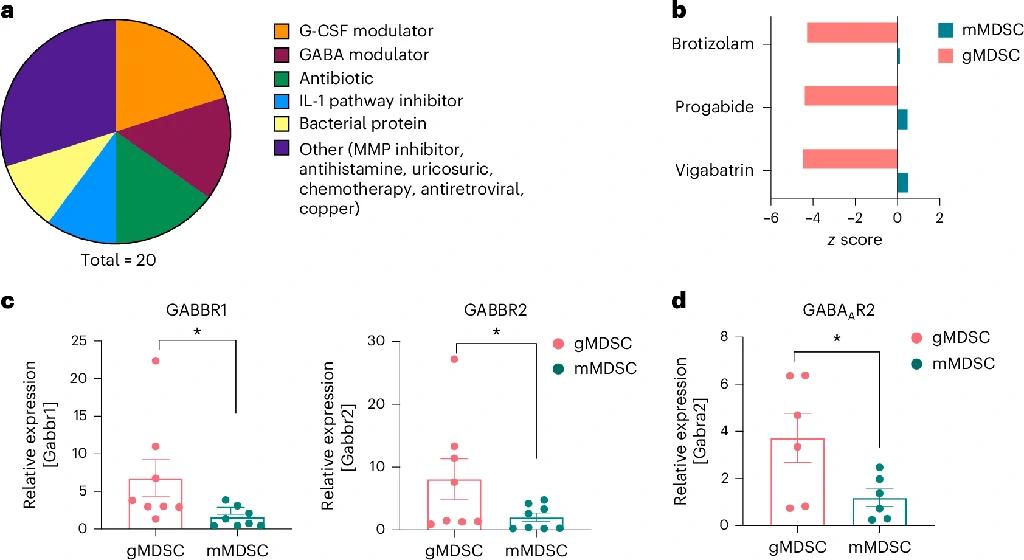
Figure 1. gMDSCs express GABA receptors; network medicine predicts three GABA pathway-modulating drugs.
Among 20 candidate drugs predicted to target gMDSCs, three were identified as regulators of the GABA pathway:Pregabalin、Progabalin、Brotizolam,Additionally, gMDSCs exhibited significantly higher GABA receptor expression than mMDSCs.(Original figure, CC BY-NC-ND 4.0)
03. Mechanistic Discovery: A Metabolic Pathway Activated Exclusively in Female gMDSCs
To investigate how GABA influences gMDSCs, researchers cultured mouse MDSCs overnight in the presence of GABA and performed metabolomic analysis.The results revealed a striking sex-specific response: only female gMDSCs accumulated large amounts of L-arginine (L-Arg) and showed significant activation of arginine synthesis and metabolic pathways. In contrast, male MDSCs and female mMDSCs exhibited little to no metabolic change.
Further mechanistic studies demonstrated that GABA signals through GABBR to selectively upregulate the arginine transporter Slc7a2 (CAT2) in female gMDSCs. Increased arginine uptake subsequently activates NOS2 (inducible nitric oxide synthase), leading to nitric oxide production and the generation of the potent oxidant peroxynitrite (ONOO⁻). This pathway ultimately suppresses the proliferation and cytotoxic activity of CD8⁺ T cells.Importantly, treatment with either a NOS2 inhibitor or peroxynitrite scavengers such as uric acid and edaravone completely restored T-cell function, confirming that the immunosuppressive effect is mediated through this metabolic axis.
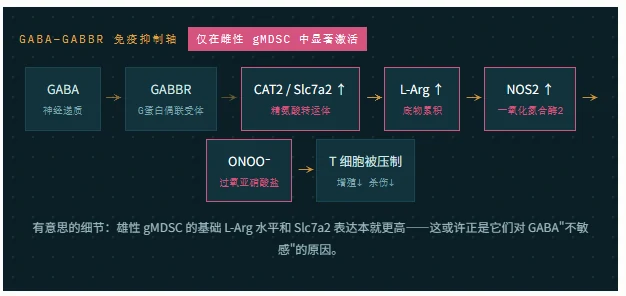
Figure 3. GABBR activation increases NOS2 expression and peroxynitrite production in female gMDSCs.
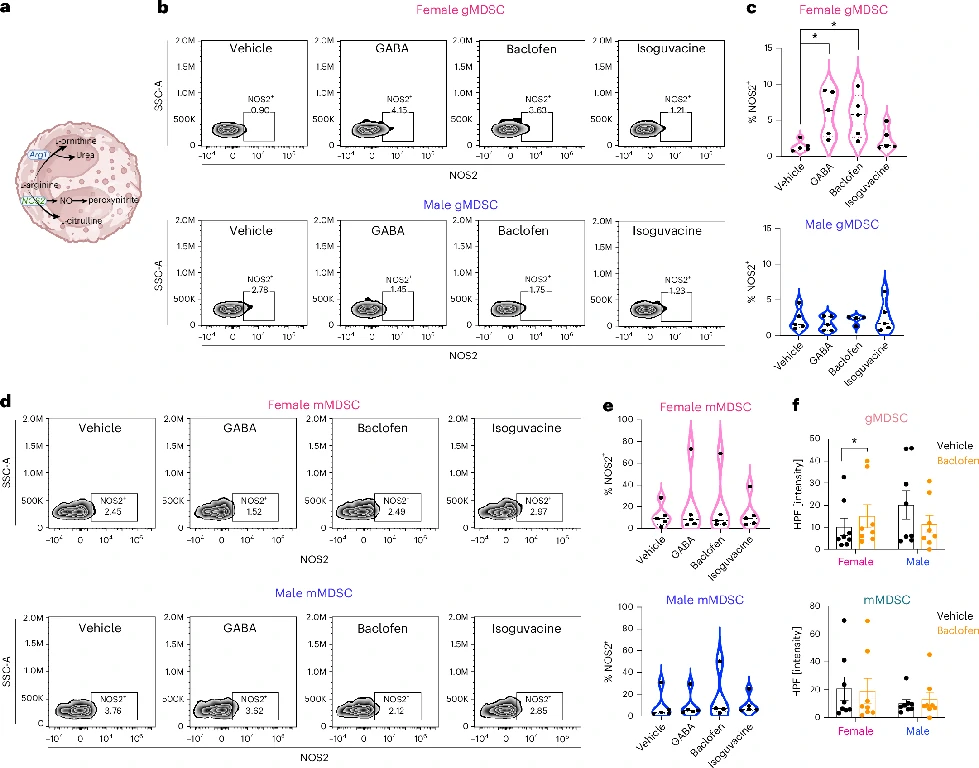
Both GABA and the selective GABBR agonist baclofen significantly increased NOS2 expression and peroxynitrite generation in female gMDSCs, whereas activation of GABAA receptors did not produce the same effect. No comparable changes were observed in male gMDSCs.
04. In Vivo Validation: Both “Pressing the Accelerator” and “Releasing the Brake” Occur Only in Females
Validation 1: Activating GABBR Accelerates Tumor ProgressionResearchers treated immunocompetent mice bearing SB28 or GL261 glioma tumors with the GABBR agonist baclofen.In female mice, median survival dropped dramatically from 21 days to 15 days (P = 0.001). However, no effect was observed in male mice or in immunodeficient NCG mice of either sex. These findings indicate that the tumor-promoting effect of GABBR activation depends entirely on an intact immune system.
Although the total number of tumor-infiltrating T cells remained unchanged, their functionality was significantly impaired. Markers of proliferation and cytotoxicity—including Ki67, Granzyme B, and TNF—were all markedly reduced in female tumors following baclofen treatment.
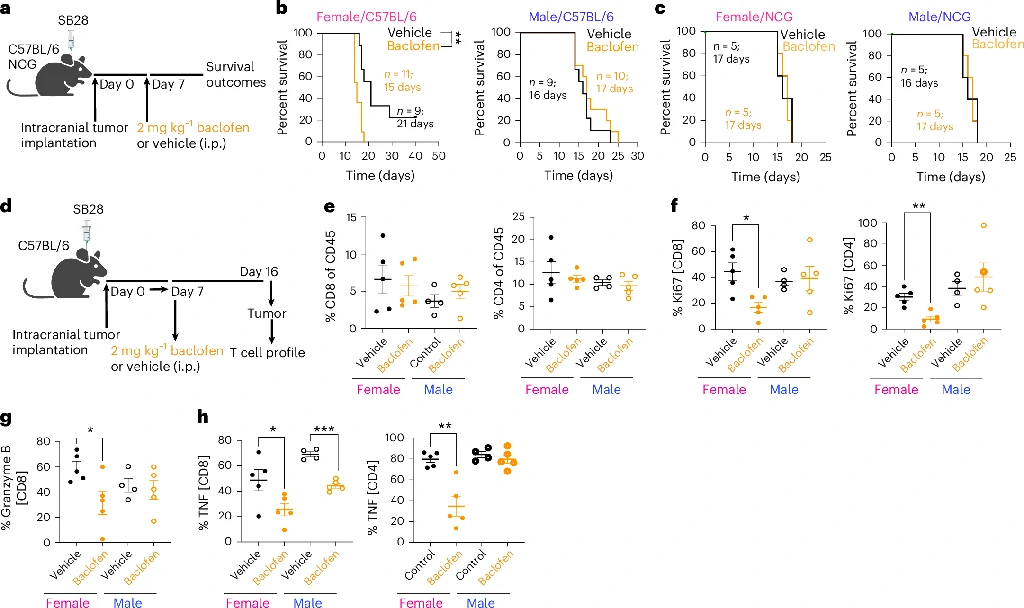
Figure 5. Baclofen selectively shortens survival and suppresses T-cell function in female tumor-bearing mice.
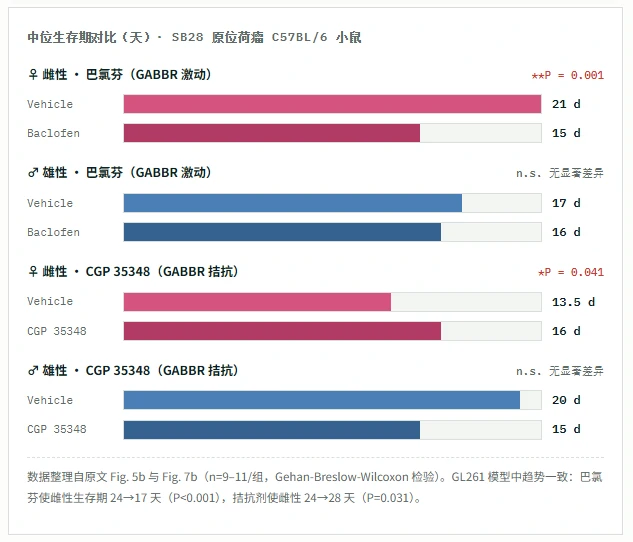
Additional analysis in the GL261 model revealed the same trend:Baclofen reduced female survival from 24 to 17 days (P < 0.001).Conversely, GABBR antagonism increased survival from 24 to 28 days (P = 0.031).Validation 2: Blocking GABBR Improves Survival
Researchers then tested the GABBR antagonist CGP 35348.Treatment significantly prolonged survival in female tumor-bearing mice and markedly reduced NOS2 expression in tumor-infiltrating gMDSCs. Once again, male mice showed no measurable benefit.
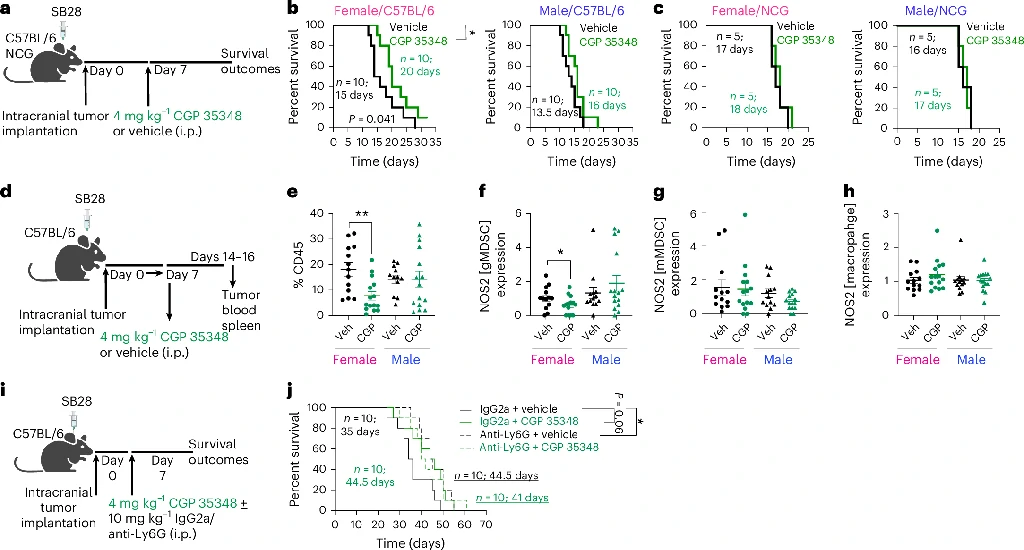
Figure 7. GABBR inhibition prolongs survival in female mice and decreases NOS2 expression in gMDSCs.
Notably, once gMDSCs were depleted, CGP 35348 provided no additional survival advantage, demonstrating that the therapeutic effect is mediated specifically through gMDSCs.
Three independent lines of evidence further confirmed the mechanism:The NOS2 inhibitor aminoguanidine abolished the tumor-promoting effect of baclofen.Female mice lacking the arginine transporter CAT2 became resistant to baclofen-induced tumor acceleration.Depletion of gMDSCs using anti-Ly6G antibodies significantly improved survival regardless of baclofen treatment.
05. Returning to Patients: GABA Is Indeed Elevated in Female Glioblastoma Tumors
The findings observed in mouse models were further supported by human patient data.Using publicly available single-cell sequencing datasets (GSE117891), researchers analyzed immune cells infiltrating human gliomas and discovered that tumor-infiltrating immune cells from female glioma patients displayed significantly enriched GABA-related transcriptional signatures (P < 2.2 × 10⁻¹⁶). In addition, GABAB receptor expression was generally higher than GABAA receptor expression in these immune cells.
Further analysis revealed that multiple tumor-associated immune populations—including:tumor-associated macrophages (TAMs),microglia,neutrophils / granulocytic MDSCs (gMDSCs),all showed significantly higher expression of GABBR1 and GABBR2 in female patients compared with male patients.
Mass spectrometry analysis provided additional evidence:Female patients with high-grade brain tumors (n = 2) exhibited higher GABA concentrations in tumor tissues compared with male patients (n = 6).Female mouse SB28 glioma tumors also showed increased GABA levels (P = 0.018).
Moreover, peripheral blood mononuclear cells (PBMCs) from healthy female donors showed a similar response: stimulation with baclofen induced increased NOS2 expression in gMDSCs, suggesting that this GABA–GABBR–NOS2 signaling pathway is conserved in humans.
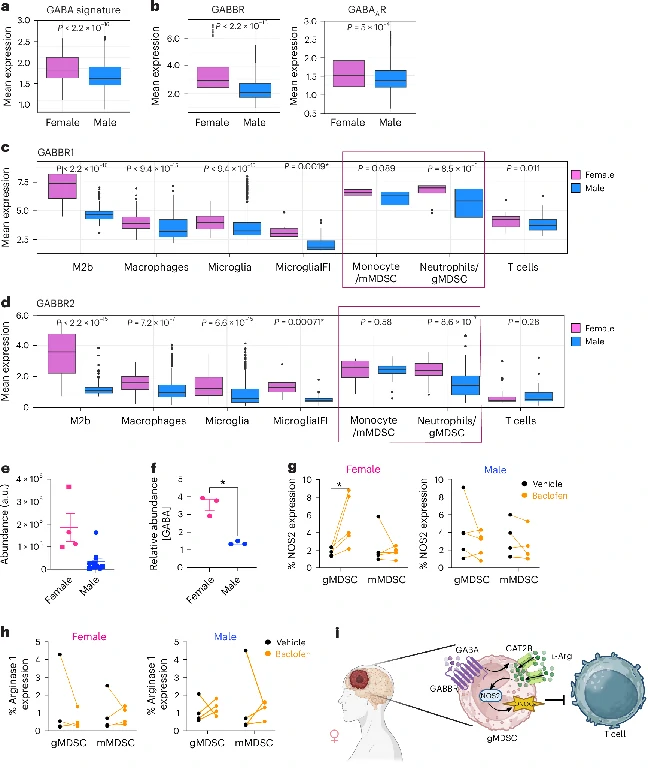
Figure 8. The GABA–GABBR Signaling Axis Is Elevated in Women with GBM
Figure 8 |Female GBM patients exhibit:Enrichment of GABA signaling signatures in immune cells.Increased expression of GABBR receptors.Higher GABA concentrations in tumor tissues.In addition, gMDSCs from healthy female donors showed increased NOS2 expression after baclofen stimulation (P = 0.029).Figure 8i presents the proposed model describing how the GABA–GABBR pathway shapes the immune microenvironment of female GBM.
06. Significance and Critical Perspective: Do Not Rush to Change Treatment Strategies Yet
The most impressive aspect of this study is that it successfully connects neuroscience with tumor immunology, revealing a potential therapeutic opportunity.
Previous studies have suggested that GABAAR signaling may suppress GBM cell proliferation. Therefore, selectively targeting GABBR, rather than blocking the entire GABA system, may provide a strategy to relieve immune suppression while avoiding disruption of potentially beneficial GABA-related effects.
The authors emphasize:“Our study highlights the complex interaction between neural regulation and immune responses and emphasizes that sex should be considered as a biological variable in both preclinical and clinical studies.”
— Discussion section of the original paper
However, several limitations should be considered.
First, human tissue evidence remains limited. The mass spectrometry analysis included only a small number of samples (2 female patients vs. 6 male patients) and therefore represents a correlation rather than definitive proof of causation.
Second, CGP 35348 is currently a research tool compound rather than a clinically approved therapeutic drug, meaning translation into human treatment remains uncertain.
Third, targeting NOS2 alone was insufficient to extend survival in control mice, suggesting that additional downstream mechanisms of GABBR signaling—including potential involvement of microglia and macrophages—remain to be investigated.
A special note:Baclofen is a clinically used muscle relaxant.This study represents a preclinical discovery only. Patients currently taking related medications should not discontinue or adjust their medication without medical guidance. Any treatment decisions should be made under the supervision of healthcare professionals.
Key Takeaways
① GABA regulates immunity beyond its role in the nervous system.In females, GABA activates the GABBR–CAT2–L-Arg–NOS2–peroxynitrite axis in gMDSCs, resulting in suppression of T-cell anti-tumor activity.
② The effect is strongly sex-specific.Activation of GABBR accelerates tumor progression only in female mice, while GABBR inhibition prolongs survival only in females.Male mice and immunodeficient mice show no significant response.
③ Clinical evidence is emerging.Female GBM patients show:Enriched GABA signaling characteristics in tumor immune cells.
Higher tumor GABA concentrations.Potential therapeutic opportunities through selective GABBR inhibition.Original Article Information
Pathak, A., Sravya, P., Colon, B., et al.
“GABA signaling activation drives glioblastoma progression in female mice through myeloid-derived suppressor cells.”
Nature Cancer 7, 1080–1093 (2026).
DOI: 10.1038/s43018-026-01192-5
Corresponding author: Defne Bayik, Sylvester Comprehensive Cancer Center, University of Miami.