
 Publish:2026-07-03
 Source:ReedBiotech
 Views:805
As the classic gold standard for quantitative biomarker detection, the three-step sandwich ELISA — leveraging the biotin-streptavidin (BAS) system and its multi-level signal amplification capability — has long been the mainstream solution in research and in vitro diagnostics. It is widely applied to the detection of low-abundance targets such as cytokines and tissue injury markers.
However, with the surging demand for ultra-low-volume scarce samples, high-throughput batch screening, and rapid detection, the inherent limitations of the traditional three-step method have become increasingly apparent. Meanwhile, conventional one-step and micro-ELISA formats suffer from insufficient sensitivity and quantitative distortion. The industry has long been trapped in a persistent dilemma: “sensitive but cumbersome, or simple but inefficient.”
I. Traditional Three-Step BAS Sandwich ELISA: Advantages and Unignorable Application Pain Points
The three-step biotin-streptavidin sandwich ELISA builds a multi-level amplification pathway through the ultra-high specific affinity between biotin and streptavidin. Its complete workflow includes capture antibody coating, sample incubation, biotinylated detection antibody incubation, SA-HRP complex incubation, multiple plate washing, color development, and absorbance reading. Multi-stage signal superposition enables detection of proteins at picogram (pg) levels, which is the core reason this technology has remained irreplaceable for decades. However, its drawbacks severely limit experimental efficiency under today’s diverse detection scenarios:

1. Cumbersome operating procedures with high labor and time costs
The full experiment requires three separate incubation steps and more than four rounds of plate washing, taking 2.5 to 4 hours in total. Manual workload surges for large batches of samples. Repeated lid-opening incubation easily causes well-edge evaporation and cross-contamination between wells, and human operational bias directly elevates intra-assay and inter-assay CV values, compromising data reproducibility.
2. Large sample consumption incompatible with scarce micro-specimens
Traditional protocols require 100 μL sample per well. Precious specimens such as mouse orbital blood, cerebrospinal fluid, trace cell supernatants, and puncture tissue homogenates are fully depleted after a single test, leaving no material for replicate testing or simultaneous multi-index detection. This creates major bottlenecks for research involving small animal models and clinical micro-samples.
II. Core Limitations of Conventional One-Step and Micro-ELISA Methods (vs. BAS Three-Step Sandwich ELISA)
To simplify operations and reduce sample consumption, early market products introduced standard one-step and micro-ELISA formats that allow simultaneous incubation of capture antibody, enzyme-labeled antibody, and antigen, reducing sample volume to 25–50 μL.
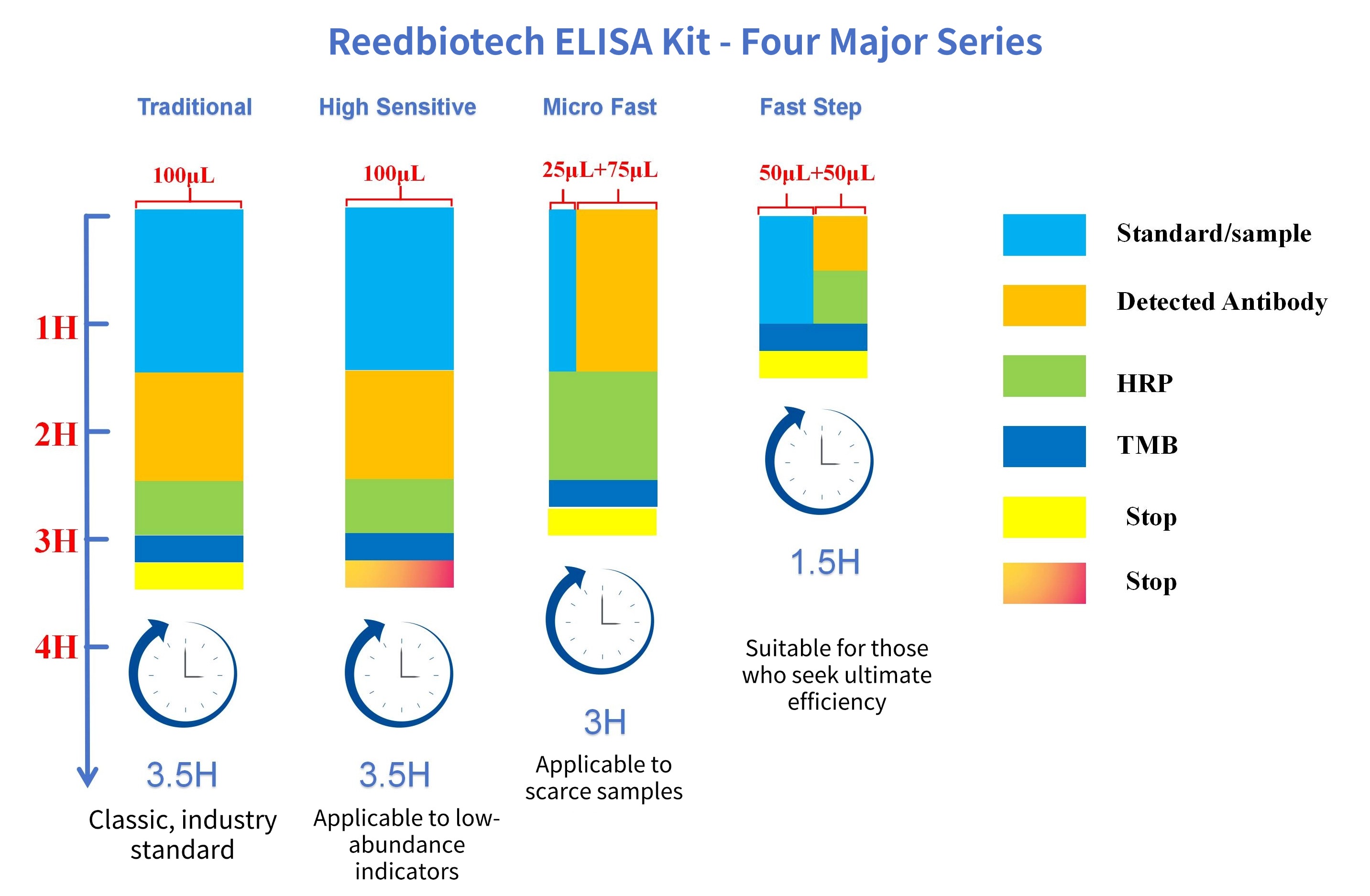
Although these one-step (Fast Step) and micro (Micro Fast) methods partially address the issues of cumbersome workflow and high sample consumption, their fundamental technical flaws remain unresolved, resulting in sensitivity far inferior to traditional three-step BAS sandwich assays for the same targets.
1. Pronounced hook effect leading to large quantification bias for high-concentration samples
Conventional one-step assays use monomer HRP-conjugated antibodies. Under simultaneous incubation conditions, high concentrations of antigen saturate both solid-phase capture antibodies and free enzyme-labeled secondary antibodies, preventing stable sandwich complex formation. This generates a hook effect, where absorbance values decline inversely as analyte concentration rises.
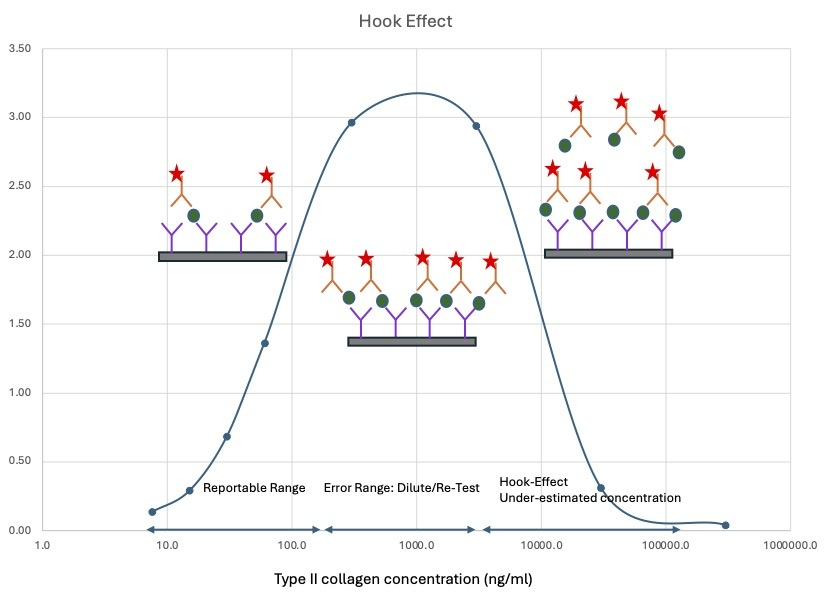
Hook Effect [3]
2. Absence of multi-stage amplification impairs detection of low-abundance biomarkers
Each antibody in traditional one-step assays is conjugated to only 1–2 HRP molecules, lacking the secondary signal amplification mechanism of the BAS system. Under identical experimental conditions, the limit of detection is 5–10 times higher than that of three-step assays. Low-expression inflammatory factors, nerve injury biomarkers, and trace endocrine hormones at sub-pg levels often fall below the detection threshold, restricting these assays to rough screening of high-abundance proteins rather than precise quantitative experiments.
3. Deteriorated signal-to-noise ratio in micro-volume systems with poor standard curve fitting
Shrunken reaction volumes increase the relative concentration of interfering substances including heteroproteins and lipids within samples. Monomeric HRP catalyzes weak colorimetric signals, blurring the distinction between specific signals and non-specific background noise. Gradients of low-concentration standards become indistinguishable, and standard curve R² values cannot stably exceed 0.99, failing to meet data requirements for drug screening and preclinical sample validation.
III. Core Technological Breakthrough: Poly-L-Lysine-Mediated PolyHRP Multi-Stage Signal Amplification System
To balance operational convenience with detection sensitivity, our R&D team reconstructed the HRP conjugation process. Using polylysine (PLL) as a multivalent molecular scaffold, we developed a biotin-streptavidin-dependent multi-enzyme signal probe that overcomes the sensitivity limitations of one-step methods at the molecular level.
Polylysine possesses numerous free primary amino groups on its side chains, serving as a linking bridge. Through controlled covalent conjugation, dozens of active HRP molecules are stably attached to a single detection antibody, forming an “antibody–polylysine–multi-HRP” composite probe. A single antibody can reliably carry 15–40 active HRP enzyme molecules. Compared with monomeric HRP labeling, this generates dozens of times higher catalytic signal at the same antigen-binding site.
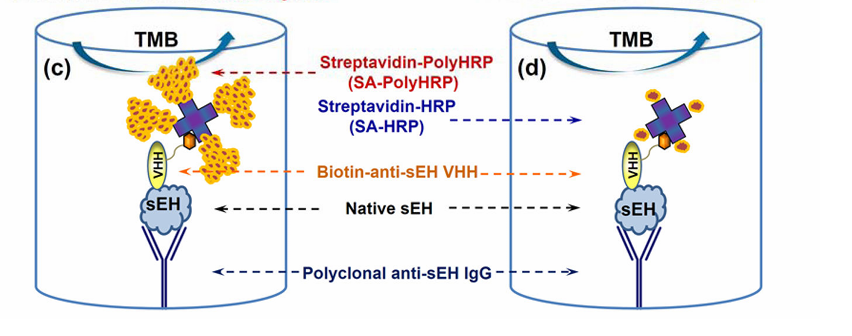
Dual-Antibody Sandwich ELISA Based on PolyHRP System [4]
At the same time, we optimized the entire reaction system: a dedicated low-matrix-interference one-step reaction buffer was formulated to balance the binding kinetics of the three reactants, significantly alleviating the hook effect at high antigen concentrations and expanding the linear dynamic range to three orders of magnitude. Anti-evaporation protectants were added to the micro-volume buffer to eliminate edge drying and inter-well variation. The solid-phase blocking formulation was also optimized to reduce non-specific adsorption from micro-sample matrices. Our standardized PolyHRP conjugation production process strictly controls enzyme activity and antibody integrity, resulting in kit performance with intra-assay CV <6% and inter-assay CV <10%, matching the reproducibility of traditional three-step sandwich kits.
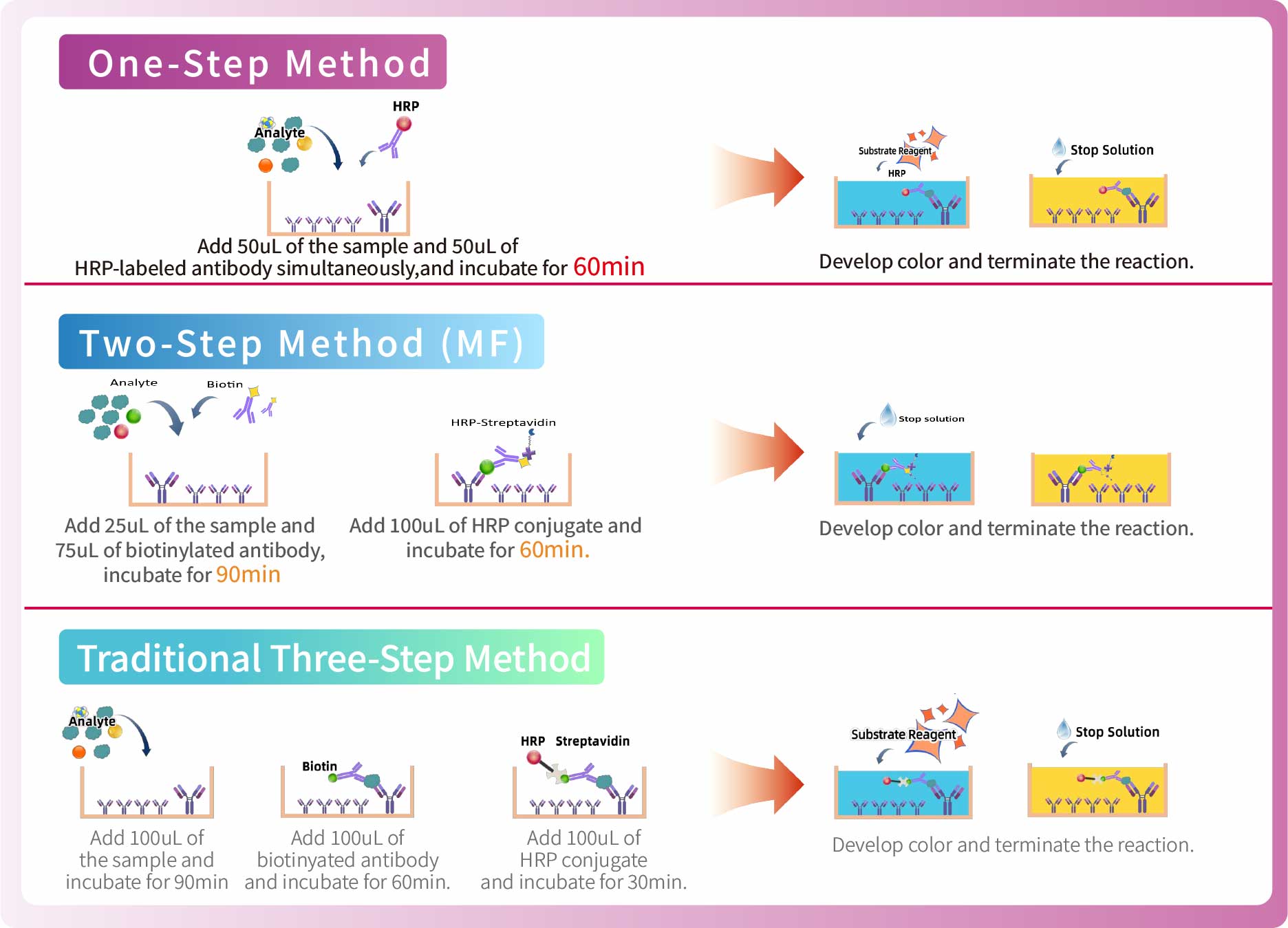
IV. Full Launch of New Fast-Step & Micro-Fast ELISA Kits with Outstanding Compatibility Across Scenarios
Leveraging the core PolyHRP amplification technology, our full product line has been upgraded. Two new series — Fast Step ELISA Kits and Micro Fast ELISA Kits — have been fully launched, covering over one hundred detection targets including cytokines, hormones, injury biomarkers, and pathogen antigens.
References
[1] Design and construction of novel molecular conjugates for signal amplification
[2] Improved ELISA for linoleate-derived diols in human plasma utilizing a polyHRP-based secondary tracer
[3] Chondrex. Understanding the Hook Effect in a One-Step Sandwich ELISA, 2026.
[4] Nanobody Based Immunoassay for Human Soluble Epoxide Hydrolase Detection Using Polymeric Horseradish Peroxidase (PolyHRP) for Signal Enhancement: The Rediscovery of PolyHRP?