
 Publish:2026-06-26
 Source:ReedBiotech
 Views:625
In the fields of IVD diagnostics and protein research, antibody conjugation technology serves as the fundamental determinant of assay sensitivity, reproducibility, and signal-to-noise ratio. While assay kits and signal amplification algorithms often receive the spotlight, the true competitive advantage lies in the precision and stability of antibody labeling.
With the growing demand for low-abundance biomarker detection and early disease diagnosis, the limitations of conventional immunoassays have become increasingly apparent. This article provides an accessible overview of the evolution of antibody conjugation technologies and introduces our proprietary ReedLytix™ conjugation platform—an enzyme-mediated site-specific oligonucleotide-antibody conjugation technology—and its application in the next-generation VeriQuant™ Immunoassay Kit, developed based on Proximity Ligation Assay (PLA) technology.
1.Antibody Conjugation: The Foundation of All Immunoassays|
Antibody conjugation is the core process of covalently linking functional molecules—such as enzymes, fluorophores, biotin, or oligonucleotides—to antibodies. Its primary objective is straightforward: to endow antibodies with detectable, amplifiable, and quantifiable signal capabilities without compromising their antigen-binding activity.
An ideal antibody conjugation technology should meet five essential criteria:
· High preservation of antibody affinity
· Controlled labeling ratio
· Excellent storage stability
· Low nonspecific binding
· Scalable and reproducible manufacturing
Whether in ELISA, chemiluminescent immunoassays (CLIA), or cutting-edge ultrasensitive protein detection platforms, the ultimate assay performance is fundamentally determined by the quality of the antibody conjugation strategy.
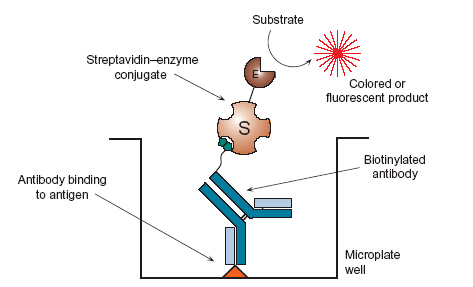
Biotin–Streptavidin System[1]
2 The Technological Divide: Random vs. Site-Specific Conjugation
Antibody conjugation technologies can generally be divided into two major categories, representing the key distinction between conventional immunoassays and high-performance ultrasensitive detection platforms.
Conventional Random Conjugation
Traditional conjugation methods rely on random chemical reactions with amino or carboxyl groups distributed across the antibody surface. These approaches are simple, cost-effective, and suitable for large-scale routine production.
However, they suffer from several inherent limitations:
· Random labeling may modify the antigen-binding Fab region.
· Reduced antibody affinity and activity.
· Significant batch-to-batch variation.
· Higher background noise.
· Typically limited to pg/mL-level detection, making them unsuitable for trace protein analysis.

Site-Specific Conjugation
The principle of site-specific conjugation is to precisely position the labeling molecule at the Fc region of the antibody while leaving the antigen-binding Fab domains completely intact.
This strategy offers substantial advantages:
· Superior preservation of antibody activity
· Improved assay reproducibility
· Higher signal-to-noise ratio
· Enhanced analytical sensitivity
As a result, site-specific conjugation has become a key enabling technology for high-end chemiluminescence assays and single-molecule detection platforms.
Among these approaches, enzyme-mediated site-specific conjugation has emerged as the preferred strategy for oligonucleotide-antibody conjugation due to its exceptional labeling uniformity and stability.
The figure below illustrates how Sortase specifically recognizes engineered tags at the antibody Fc region, enabling highly efficient site-specific antibody conjugation.
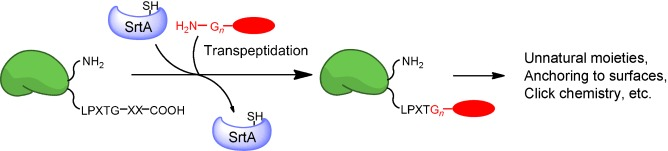
Enzyme-Mediated Conjugation Strategy[2]
3.The Next Evolution: Oligonucleotide Conjugation Enables Ultrasensitive Detection
Traditional labels—including enzymes, fluorophores, and colloidal gold nanoparticles—have inherent limitations in signal amplification, restricting the achievable detection sensitivity.
Antibody–oligonucleotide conjugation overcomes these limitations by attaching DNA probes directly to antibodies. These DNA tags enable exponential signal amplification through rolling circle amplification (RCA) or quantitative PCR (qPCR), allowing protein detection down to the fg/mL range.
This technology has become one of the leading approaches for detecting ultra-low abundance protein biomarkers.
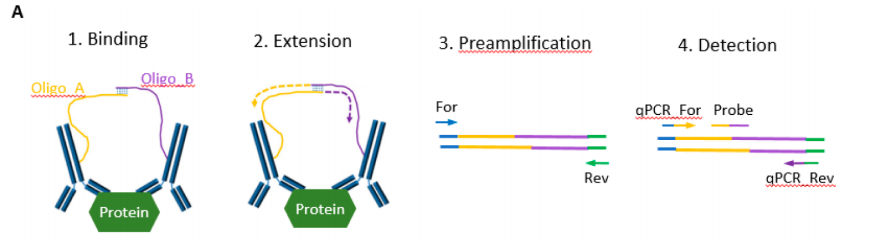
PLA-Based Protein Detection Method[3]
4.Our Proprietary Solution: The ReedLytix™ Site-Specific Conjugation Platform
Although oligonucleotide-antibody conjugation has gained widespread attention, many existing commercial approaches still rely on conventional random chemical conjugation. Consequently, challenges such as heterogeneous labeling, antibody inactivation, elevated background, and poor reproducibility continue to hinder the broader application of ultrasensitive technologies such as PLA and immuno-PCR (iPCR).
To address these challenges, we developed the proprietary ReedLytix™ platform, an enzyme-mediated site-specific oligonucleotide-antibody conjugation technology designed to overcome these limitations at their source.
Unlike conventional amine- or thiol-based random conjugation methods, ReedLytix™ utilizes proprietary enzymatic catalysis to precisely attach oligonucleotide probes to the antibody Fc region without affecting the antigen-binding domains.
This technology provides three major advantages:
· Superior Activity Preservation
Maintains native antibody affinity by completely avoiding modification of antigen-binding sites.
· Highly Uniform Labeling
Enzymatic conjugation delivers consistent labeling ratios with exceptionally low batch-to-batch variation.
· Ultra-Low Background Noise
Eliminates random labeling and significantly reduces nonspecific interactions, resulting in outstanding signal-to-noise performance.
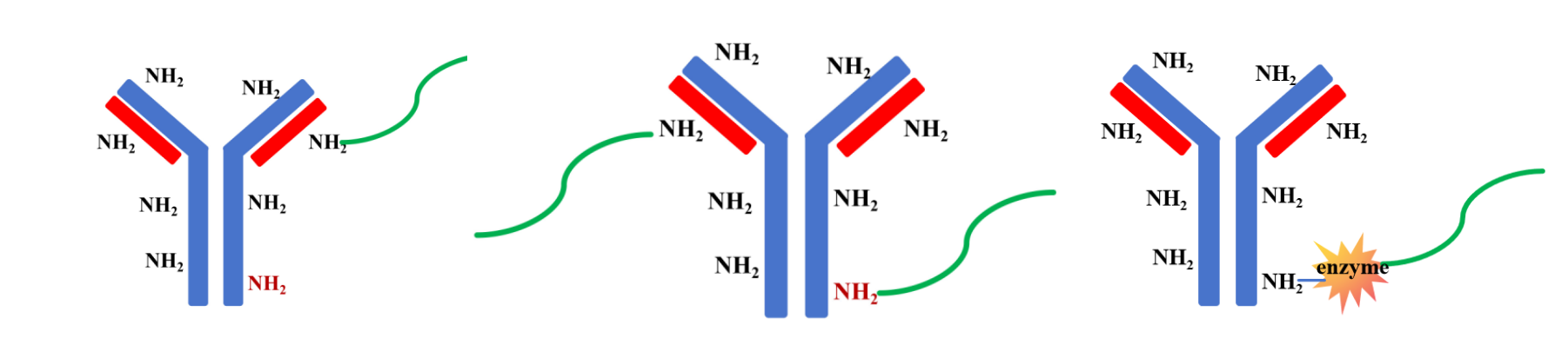
Compared with conventional random chemical conjugation (left and center), the ReedLytix™ platform (right) achieves precise site-specific conjugation with a defined labeling ratio.
ReedLytix™ Powers the VeriQuant™ Immunoassay Kit — A Next-Generation Protein Detection Solution
The Proximity Ligation Assay (PLA) combines dual-antibody target recognition with DNA-mediated proximity ligation and qPCR amplification to achieve extraordinary analytical sensitivity.
Leveraging the ReedLytix™ platform, each matched antibody pair is conjugated with a unique oligonucleotide probe. Upon simultaneous binding to the target protein, the DNA probes are brought into close proximity, triggering hybridization, ligation, and qPCR amplification to generate highly specific and massively amplified signals.
Compared with conventional ELISA, the VeriQuant™ Immunoassay Kit offers significant advantages for:
· Detection of low-abundance biomarkers, such as cytokines
· Samples with wide dynamic concentration ranges, including cell culture supernatants
· Precious or limited-volume samples, such as mouse serum
5.Technology Comparison
|
Feature |
Conventional Random Amine Conjugation |
ReedLytix™ |
|
Antibody Activity Retention |
60–75%; susceptible to activity loss |
85–95%; highly preserved and stable |
|
Batch-to-Batch Consistency |
High variability; poor reproducibility |
Enzymatically controlled; extremely low CV |
|
Signal-to-Noise Ratio |
Moderate; prone to high background |
Ultra-low background; exceptional signal-to-noise ratio |
|
Analytical Sensitivity |
pg/mL level |
fg/mL ultrasensitive detection |
|
Technical Characteristics |
Simple process with limited performance |
Precise site-specific conjugation with defined labeling ratio |
[1]The avidin-biotin complex in immunology
[2] Simone Jeger ,Site-Specific and Stoichiometric Modification of Antibodies by Bacterial Transglutaminase[J].Angew. Chem. Int. Ed. 2010, 49, 9995–9997.
[3]Simple Method To Prepare Oligonucleotide-Conjugated Antibodies and Its Application in Multiplex Protein Detection in Single Cells