
 Publish:2026-04-10
 Source:ReedBiotech
 Views:610
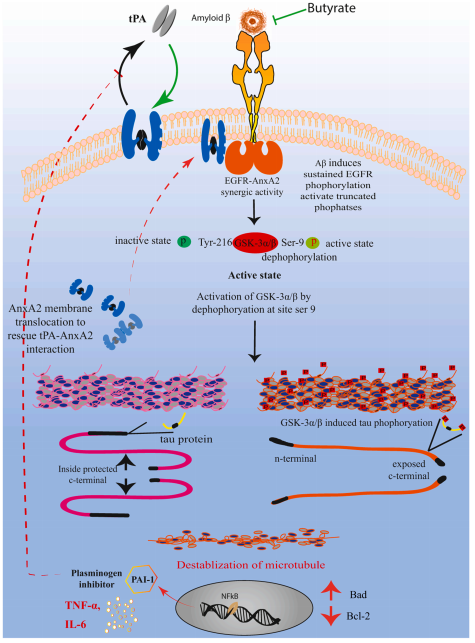
Alzheimer’s disease (AD) has emerged as a prominent research focus in recent years. Its two key pathological hallmarks—amyloid-β (Aβ) deposition and hyperphosphorylation of tau protein—have long been the central themes of investigations in this field. A recent study published in Ecotoxicology and Environmental Safety has systematically demonstrated that the epidermal growth factor receptor (EGFR)–Annexin A2 (AnxA2) signaling axis acts as a core upstream pathway that drives tau pathology, neuroinflammation, and synaptic impairment in AD.
The results of this study revealed that Aβ₁₋₄₂ and aluminum salts induce the pathological binding and activation of EGFR and AnxA2, followed by the recruitment of galectin-3 (Gal-3) to form a pro-inflammatory complex. This signaling cascade directly mediates the hyperphosphorylation of tau protein at Thr231 and Ser396 residues through the phosphatidylinositol 3-kinase (PI3K)/protein kinase B (Akt)/glycogen synthase kinase-3α/β (GSK-3α/β) pathway. Concurrently, it elicits fibrinolytic imbalance, characterized by decreased tissue-type plasminogen activator (tPA) levels and increased plasminogen activator inhibitor-1 (PAI-1) expression, as well as oxidative stress, neuronal apoptosis, and subsequent cognitive impairment. Notably, sodium butyrate, a histone deacetylase (HDAC) inhibitor, can comprehensively block this pathological pathway, with preventive administration exhibiting significantly superior efficacy compared to therapeutic administration.
In brief, the EGFR–AnxA2 axis represents a critical target for the early prevention and treatment of Alzheimer’s disease, while sodium butyrate serves as an intervention molecule with high translational value.
Original link:https://www.sciencedirect.com/science/article/pii/S0147651326001041?via%3Dihub
Research Implications and Scientific References
1. Further expansion of the target concept: Previously, EGFR was mainly focused on research in the field of tumors, but this study regards it as a key driving axis of tau pathology in Alzheimer's disease, providing a new perspective for the exploration of targets for neurodegenerative diseases.
2. The experimental model can be directly reused: In vitro, the SH-SY5Y/PC12 neuronal differentiation model combined with Aβ₁₋₄₂-induced damage was used; in vivo, the AlCl₃ combined with D-galactose was used to construct a sporadic AD rat model, both of which can stably reproduce cognitive impairment and typical pathological phenotypes. The entire system has strong repeatability and is convenient for subsequent studies to directly refer to.
3. Complete and clear mechanism research paradigm: The research follows the complete logical chain of "signal axis activation → downstream kinase regulation → phosphorylation of tau protein at specific sites → abnormal inflammation, fibrinolysis, and apoptosis → behavioral changes", with rigorous and closed mechanism demonstration, which can provide a mature paradigm for similar studies.
4. Outstanding application value: Sodium butyrate, as a short-chain fatty acid derived from the gut, has high safety and is readily available. It holds great potential for development in areas such as nutritional intervention and early prevention, providing practical ideas for non-drug intervention studies on Alzheimer's disease.
Reedbiotech ELISA Kit, Supporting High-Scoring Research on Alzheimer's Disease
In this study, the Reedbiotech ELISA Kit was used to quantitatively detect key indicators such as Annexin A2 (Human ANXA2 ELISA KIT, item number: RE1251H), TNF-α (Human TNF-α ELISA KIT, item number: RE1060H), and IL-6 (Human IL-6 ELISA KIT, item number: RE3186H), which are the core means for mechanism verification. Precise and stable quantitative data form the basis of high-scoring articles. From signal axis validation to elucidation of pathological mechanisms, from basic experiments to publication of articles, our ELISA Kit provides full-process support, ensuring that every innovative idea can be transformed into reliable data.
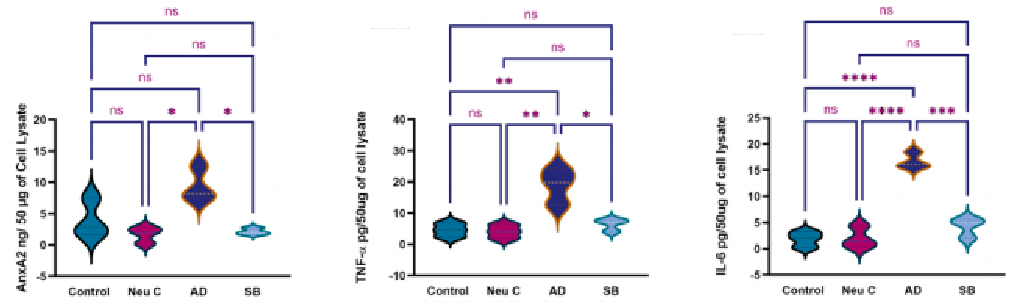
ELISA quantitative detection of AnxA2, TNF-α and IL-6 in 50 µg of total cell lysate
The AD research has traversed a long path of exploration, moving from focusing on the pathological manifestations of Aβ and tau, to now continuously tracing back to earlier and more fundamental upstream driving mechanisms. Each breakthrough in thinking has opened up new windows for clinical prevention and treatment. For researchers, true breakthroughs are never about following the old path; instead, they are about daring to break out of the classic framework and search for new answers in cross-targets and cross-pathways.