
 Publish:2026-04-30
 Source:ReedBiotech
 Views:779
Many people have experienced migraines: a severe, throbbing pain on one side of the head, accompanied by nausea, photophobia, and phonophobia; in severe cases, it can even prevent them from working or living normally. Migraines have long been a hot topic in medical research, and CGRP, once an obscure "small molecule," has gradually become a key to solving the mystery of migraines.
What is CGRP?
CGRP, short for calcitonin gene-related peptide, is a neuropeptide composed of 37 amino acids, primarily in two subtypes: α-CGRP (also known as CGRP1) and β-CGRP (also known as CGRP2). α-CGRP is produced by alternative splicing of the CALCA gene and is mainly expressed in the trigeminal ganglion and dorsal root ganglion; β-CGRP is encoded by the CALCB gene and is highly expressed primarily in the enteric nervous system. CALCA and CALCB have similar mature peptide chain structures, including N-terminal disulfide bonds and C-terminal amidation, with highly conserved secondary structures. Under normal physiological conditions, CGRP participates in regulating various physiological processes such as vasodilation, nerve conduction, and inflammatory responses—for example, helping to dilate blood vessels, maintain cardiovascular stability, regulate normal nervous system function, and even play a regulatory role in immune responses.
CGRP receptors and signal transduction
The most classic CGRP receptor is a heterodimer composed of a calcitonin receptor-like receptor (CLR) and receptor activity-modifying protein 1 (RAMP1). The CLR alone cannot localize to the cell membrane and is non-functional. RAMP1 acts as a molecular chaperone, helping the CLR transport to the membrane surface and determining the high affinity of the receptor for CGRP; it is an essential protein for CGRP to function. Other receptors include the AM1/2 receptor (CLR + RAMP2/3) and the CT receptor (CTR). Other receptors will only bind when the cell does not express the CLR, or when the classic receptor is saturated, blocked, or when the CGRP concentration is extremely high.
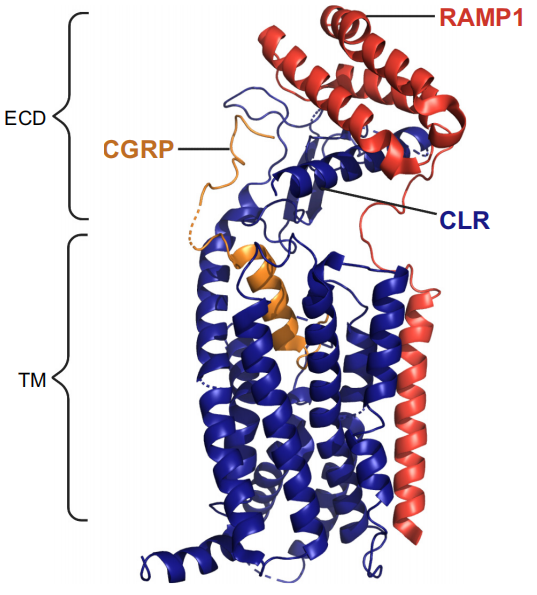
Structural model of the active calcitonin gene-related peptide (CGRP) receptor [Russo, et al.].
Once CGRP binds to its receptor (CLR+RAMP1), a multi-cascaded, multi-branched, and highly coordinated signal transduction network is immediately initiated within the cell, ultimately producing a series of biological effects such as vasodilation, pain sensitization, neuroinflammation, and cell protection. How does it accomplish this signal transduction?
After CGRP binds to its receptor, the receptor undergoes a conformational change, activating the Gs protein. Gs activates adenylate cyclase (AC), rapidly converting ATP into cAMP (the second messenger), leading to a significant increase in cAMP concentration. This, in turn, activates PKA (protein kinase A), which is the master switch for all CGRP's effects. Next, PKA begins to "split up": in vascular smooth muscle, PKA opens KATP potassium ion channels, causing hyperpolarization of the cell membrane. The influx of calcium ions prevents their inward movement, resulting in potent vasodilation. In the trigeminal/sensory nerves, PKA phosphorylates the CREB transcription factor, which, upon entering the nucleus, initiates genes related to pain sensitization, neuroinflammation, and migraine. Simultaneously, it activates NOS (nitric oxide synthase) to produce NO, further amplifying the vasodilatory effect. In the heart and inflammatory cells, it regulates downstream proteins, exerting anti-inflammatory, anti-apoptotic, and cardioprotective effects. In addition, CGRP can also transduce signals through non-G protein pathways and the phosphatidylinositol signaling pathway.
CGRP core physiological functions
CGRP is considered the most potent endogenous microvasodilator in the human body, with a stable and sustained effect lasting 5-6 hours. It is also an important cardiovascular protective factor, combating hypertension, myocardial hypertrophy, and ischemia-reperfusion injury. In the nervous system, CGRP participates in pain transmission, central sensitization, and trigeminal nerve regulation, and is closely related to pain perception. Regarding inflammation and repair, it can bidirectionally regulate inflammatory responses and effectively promote wound healing and angiogenesis. Furthermore, CGRP inhibits insulin secretion, significantly impacting processes such as obesity and glucose and lipid metabolism.
Why has CGRP become the "number one target" for migraines?
Studies have found that during a migraine attack, CGRP levels in the body significantly increase, especially at the site of the pain, where CGRP concentrations are several times higher than normal. Excessively high CGRP levels over-dilate blood vessels in the brain, stimulating nerve endings and triggering neurogenic inflammation, which in turn triggers severe headaches. This is why almost all migraine medications today target CGRP or its receptors. Currently, two classes of drugs have been developed: small molecule CGRP antagonists, such as ubrogepant, rimegepant, and atogepant, for the acute treatment of migraines; and CGRP monoclonal antibodies, such as Fremanezumab, Galcanezumab, and Eptinezumab, for the prevention of migraines.
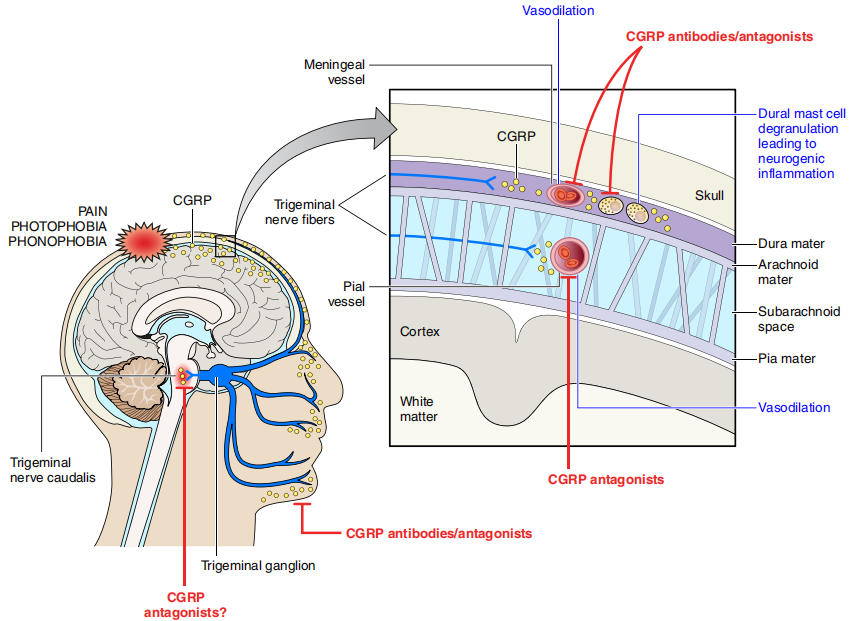
CGRP is involved in the pathophysiological process of migraine [Russell, et al.].
From a pluripotent neuropeptide to a highly anticipated core target for migraines, the value of CGRP has been redefined. Based on its well-defined receptor and signal regulation mechanisms, CGRP-targeting research continues to gain momentum, laying a solid theoretical foundation for exploring the mechanisms of migraines and for clinical intervention.
References:
1.Russo AF, Hay DL. CGRP physiology, pharmacology, and therapeutic targets: migraine and beyond. Physiol Rev. 2023;103(2):1565-1644. doi:10.1152/physrev.00059.2021
2.Russell FA, King R, Smillie SJ, Kodji X, Brain SD. Calcitonin gene-related peptide: physiology and pathophysiology. Physiol Rev. 2014;94(4):1099-1142. doi:10.1152/physrev.00034.2013
3.Cohen, F., Yuan, H. & Silberstein, S.D. Calcitonin Gene-Related Peptide (CGRP)-Targeted Monoclonal Antibodies and Antagonists in Migraine: Current Evidence and Rationale. BioDrugs 36, 341–358 (2022). doi:10.1007/s40259-022-00530-0
4.Poyner, DR, Sexton, PM, et.al. International Union of Pharmacology. XXXII. The Mammalian Calcitonin Gene-Related Peptides, Adrenomedullin, Amylin, and Calcitonin Receptors. Pharmacological Reviews 2002;54 (2):233-246. Pharmacological Reviews, doi: 10.1124/pr.54.2.233.