
 Publish:2026-04-20
 Source:ReedBiotech
 Views:645
Are you worried about hair loss due to work-related stress? Or struggling with hair thinning caused by medical side effects?
A recent scientific breakthrough has finally shed light on the long-standing mystery of how stress leads to hair loss. In April 2026, a team led by Zhicai Yue at Shenzhen University, in collaboration with the University of Hamburg in Germany and others, published a landmark study in the prestigious journal Proceedings of the National Academy of Sciences (PNAS).
The study reveals that seemingly unrelated stressors—such as chemotherapy drugs, noise pollution, aging, and obesity—all converge on a single molecular “switch” within hair follicles: the Egr1-Shh axis.
Key Finding: A Unified Stress Pathway
Various stressors activate the “immediate early gene” Egr1, which acts like a molecular lock. Through an enhancer element called HSRE (Hair Stress Response Enhancer), Egr1 suppresses the expression of the critical hair growth signaling molecule Sonic hedgehog (Shh). Once Shh is inhibited, hair follicle growth halts, leading to hair loss.
1. Identifying a Universal Stress Sensor
Hair follicles are among the most stress-sensitive organs in the body. While it has long been known that stress is harmful, the exact mechanism remained unclear.
Using mouse models, the researchers performed genome-wide analyses with ATAC-seq and CUT&Tag techniques to map open chromatin regions in hair follicle epithelial cells. They discovered a unique enhancer located 130 kb upstream of the Shh gene, which they named HSRE.
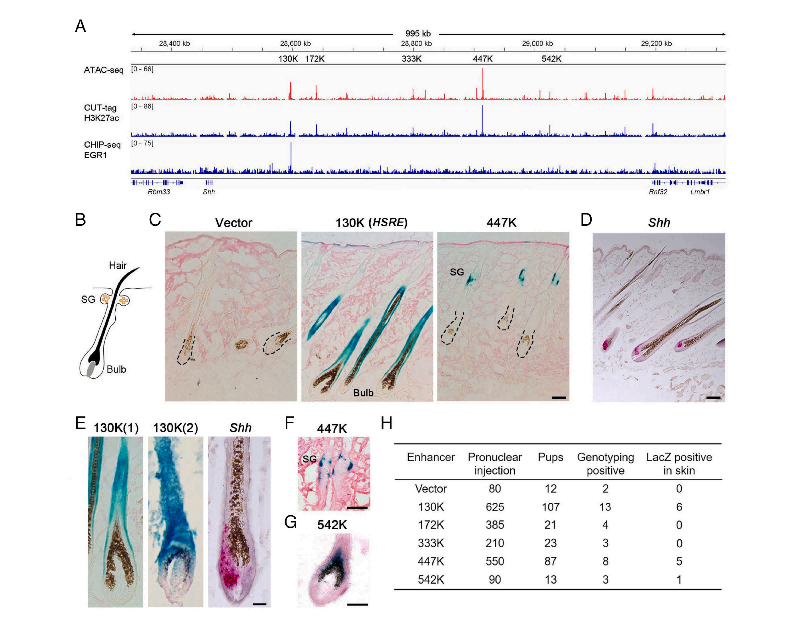
Figure 1: Localization and functional validation of the HSRE enhancer (A: genomic landscape; C–E: enhancer activity in transgenic mice)
This enhancer acts as the “Achilles’ heel” of hair follicles. Whether exposed to chemotherapy agents (such as cyclophosphamide), high-frequency noise (25 kHz ultrasound), or internal stresses like aging and metabolic dysfunction, all stress signals converge on this site.
2. Molecular “Cat-and-Mouse” Game
The researchers reconstructed the molecular cascade:
· Stress Activation: External stress (e.g., noise-induced neuroendocrine responses) or internal stress (e.g., DNA damage from chemotherapy) rapidly activates Egr1.
· Target Binding: Elevated Egr1 protein binds tightly to the HSRE enhancer.
· Gene Silencing: This interaction suppresses Shh expression. Since Shh acts as the “fuel” for hair follicle growth, its inhibition halts cell proliferation and regeneration.
3. Experimental Evidence: Removing HSRE Protects Hair
Two key experiments confirmed the mechanism:
①. Chemotherapy Model:
After chemotherapy treatment, normal mice showed rapid hair follicle degeneration and entered the resting phase. In contrast, mice lacking HSRE or Egr1 maintained active hair growth and were largely protected from hair loss.
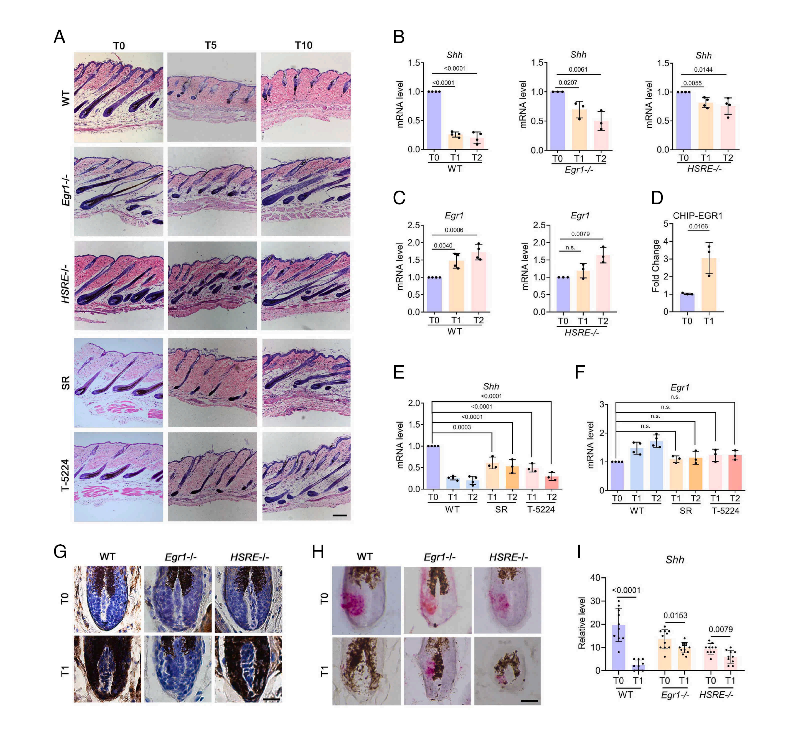
Figure 2: Regulation of chemotherapy-induced hair follicle damage by the Egr1–Shh axis (A: comparison of hair follicle morphology across different groups of mice)
②. Noise Exposure Model:
Mice exposed to high-intensity noise exhibited reduced hair bulb size and increased apoptosis. However, HSRE-deficient mice showed minimal damage.
Additionally, aging and obesity were found to elevate Egr1 levels, suppress Shh expression, and slow hair regeneration—explaining why middle-aged and overweight individuals are more prone to thinning hair.
4. Future Anti-Hair Loss Therapies
With the root cause identified, potential treatments are emerging.
The researchers tested two known AP-1 inhibitors—SR11302 and T-5224—which suppress Egr1 expression. Remarkably, even under chemotherapy or noise stress, treated mice maintained Shh expression and showed significant recovery of hair follicles.
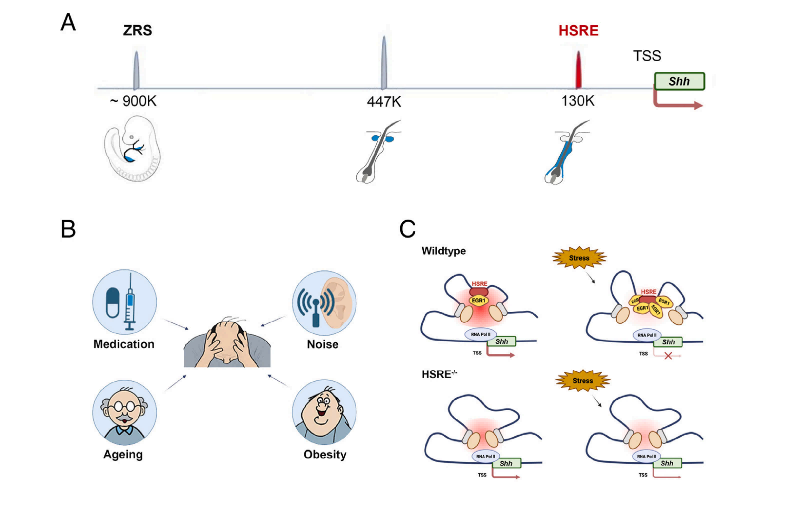
Mechanistic model of how the Egr1–Shh axis integrates internal and external stressors to induce hair disorders
This study not only explains the biological basis of hair loss but also introduces a new paradigm: both external environmental stressors (e.g., noise, drugs) and internal physiological stress (e.g., aging, obesity) converge on a shared molecular pathway (Egr1-HSRE-Shh) to disrupt organ growth and regeneration.
Although targeted therapies are still under development, the message is clear: managing stress is essential for protecting your hair. Whether emotional stress or metabolic burden, both can attack your hair through the same biochemical pathway.
Maintaining a healthy lifestyle and reducing exposure to environmental stressors may currently be your best defense against hair loss.
Reference: Chen et al. Convergence of external and internal stressors on a stress-responsive enhancer of the Sonic hedgehog gene to induce hair disorders. PNAS (2020). DOI: 10.1073/pnas.2529339123