
Size:
96 T
48 T
Price:
Delivery: Order now, ship in 3 days
| Product Name | Mouse TL1A(Tumor Necrosis Factor Related Ligand 1A) ELISA Kit | Species | Mouse |
| Uniprot ID | O95150 | Alternative Names | TNFSF15,TL1,VEGI, VEGI192A,TNF ligand-related molecule 1,TNF superfamily ligand TL1A,vascular endothelial cell growth inhibitor,vascular endothelial growth inhibitor-192A |
| Detection method | Sandwich | Sensitivity | 14.22 pg/mL |
| Standard | 2000pg/mL | Detection Range | 31.25-2000 pg/mL |
| Sample type | Serum, Plasma, cell supernatant,Tissue homogenate and Other biological samples;Sample Volume=100μL | ||
| Reaction time | 3.5H | Research Area | Cytokine;Tumor immunity;Infection immunity;Dermatology; |
| Test principle | This ELISA kit uses the Sandwich-ELISA principle. The micro ELISA plate provided in this kit has been pre-coated with an antibody specific to Mouse TL1A. Standards or samples are added to the micro ELISA plate wells and combined with the specific antibody. Then a biotinylated detection antibody specific for Mouse TL1A and Avidin-Horseradish Peroxidase (HRP) conjugate are added successively to each micro plate well and incubated. Free components are washed away. The substrate solution is added to each well. Only those wells that contain Mouse TL1A, biotinylated detection antibody and Avidin-HRP conjugate will appear blue in color. The enzyme-substrate reaction is terminated by the addition of stop solution and the color turns yellow. The optical density (OD) is measured spectrophotometrically at a wavelength of 450 nm ± 2 nm. The OD value is proportional to the concentration of Mouse TL1A. You can calculate the concentration of Mouse TL1A in the samples by comparing the OD of the samples to the standard curve. | ||
As the OD values of the standard curve may vary according to the conditions of the actual assay performance (e.g. operator, pipetting technique, washing technique or temperature effects), the operator should establish a standard curve for each test. Typical standard curve and data is provided below for reference only.
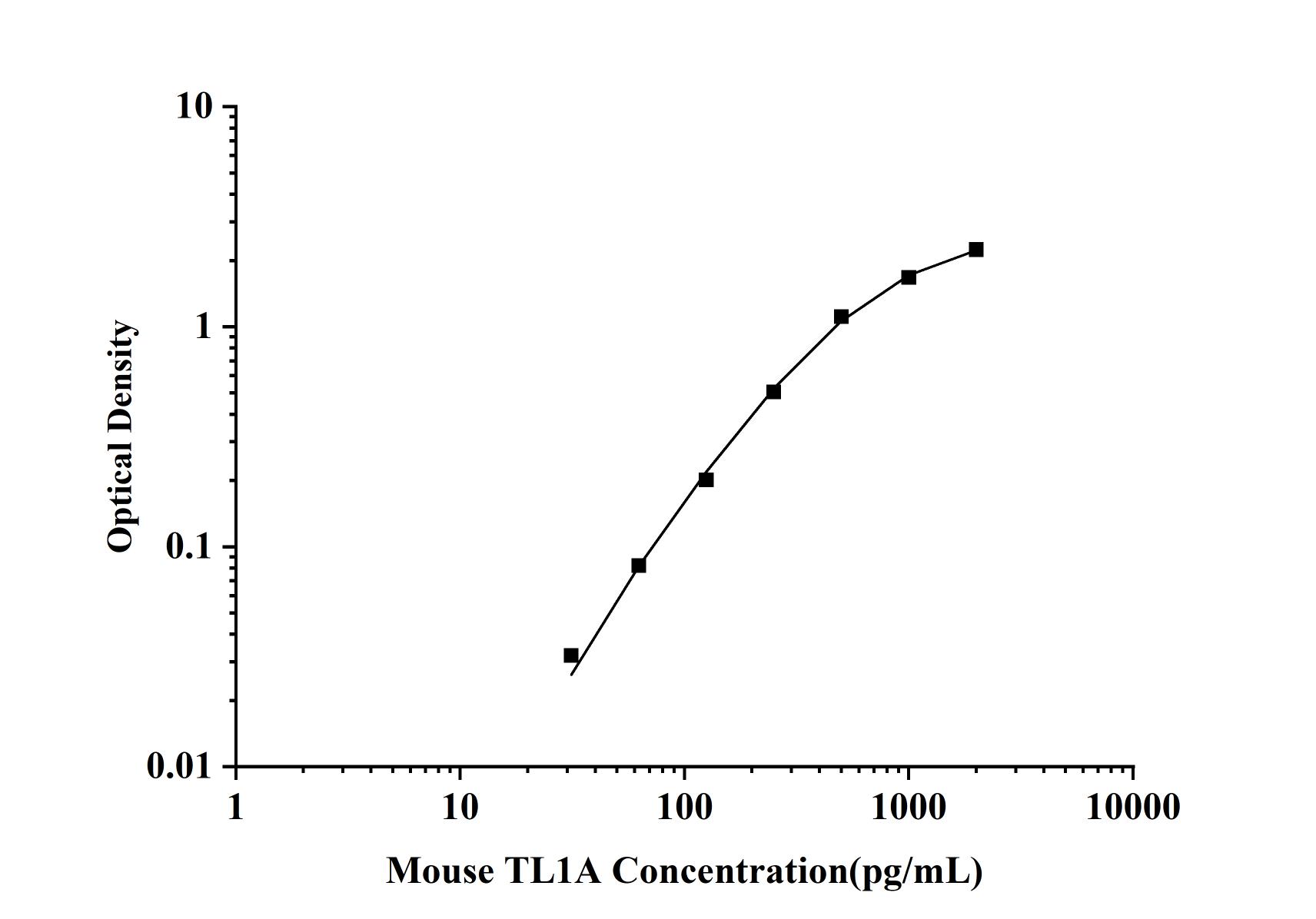
| (pg/mL) | OD | Corrected |
|---|---|---|
| 2000.00 | 2.314 | 2.241 |
| 1000.00 | 1.746 | 1.673 |
| 500.00 | 1.298 | 1.225 |
| 250.00 | 0.578 | 0.505 |
| 125.00 | 0.274 | 0.201 |
| 62.50 | 0.155 | 0.082 |
| 31.25 | 0.140 | 0.067 |
| 0.00 | 0.073 |
Intra-assay Precision (Precision within an assay): 3 samples with low, mid range and high level were tested 20 times on one plate, respectively.
Inter-assay Precision (Precision between assays): 3 samples with low, mid range and high level were tested on 3 different plates, 20 replicates in each plate, respectively.
| Intra-assay Precision | Inter-assay Precision | |||||
|---|---|---|---|---|---|---|
| Sample | 1 | 2 | 3 | 1 | 2 | 3 |
| n | 20 | 20 | 20 | 20 | 20 | 20 |
| Mean(pg/mL) | 48.552 | 313.429 | 1102 | 89.034 | 270.286 | 843 |
| Standard deviation | 3.413 | 14.386 | 42.758 | 4.309 | 21.136 | 57.324 |
| C V (%) | 7.03 | 4.59 | 3.88 | 4.84 | 7.82 | 6.8 |
The recovery of spiked at three different levels in samples throughout the range of the assay was evaluated in various matrices.
| Sample Type | Range(%) | Average Recovery(%) |
|---|---|---|
| Serum (n=8) | 92-98 | 95 |
| EDTA plasma (n=8) | 91 | 91 |
| Cell culture media (n=8) | 93 | 91 |
Samples were spiked with high concentrations of target proteins and diluted with Reference Standard & Sample Diluent to produce samples with values within the range of the assay.
| Serum (n=5) | EDTA plasma (n=5) | Cell culture media (n=5) | ||
|---|---|---|---|---|
| 1:2 | Range (%) | 89-95 | 95-103 | 91-97 |
| Average (%) | 92 | 98 | 94 | |
| 1:4 | Range (%) | 99-105 | 93-101 | 93-102 |
| Average (%) | 102 | 97 | 98 | |
| 1:8 | Range (%) | 95-104 | 93-102 | 92-100 |
| Average (%) | 100 | 98 | 95 | |
| 1:16 | Range (%) | 97-105 | 98-105 | 88-98 |
| Average (%) | 102 | 101 | 93 |