
 Publish:2026-02-06
 Source:ReedBiotech
 Views:602
Macrophages, as core cells of the body's innate immunity, have long transcended the traditional understanding of "phagocytic cells." In recent years, increasing research has confirmed that their functional plasticity and heterogeneity play an irreplaceable regulatory role in the occurrence, development, and outcome of major diseases such as tumors, neurodegenerative diseases, and metabolic diseases, serving as a "bridge" connecting immunity and disease, and becoming a core research target in recent years. As a manufacturer with many years of experience in ELISA detection technology, we have summarized the core associations between macrophages and three major diseases based on our experience in ELISA detection technology, providing practical reference for related research.
Macrophages and Tumors: Key Regulators of the Tumor Microenvironment
Tumor-associated macrophages (TAM) are the most numerous immune cells in the tumor microenvironment, and their M1/M2 polarization state directly determines the direction of tumor progression. M1 macrophages have pro-inflammatory and anti-tumor activities and can inhibit tumor growth by secreting pro-inflammatory factors such as TNF-α and IL-6. M2 macrophages, on the other hand, exhibit anti-inflammatory and pro-tumor properties and promote tumor angiogenesis, immune escape, and distant metastasis by secreting factors such as IL-10, TGF-β1, and VEGF.
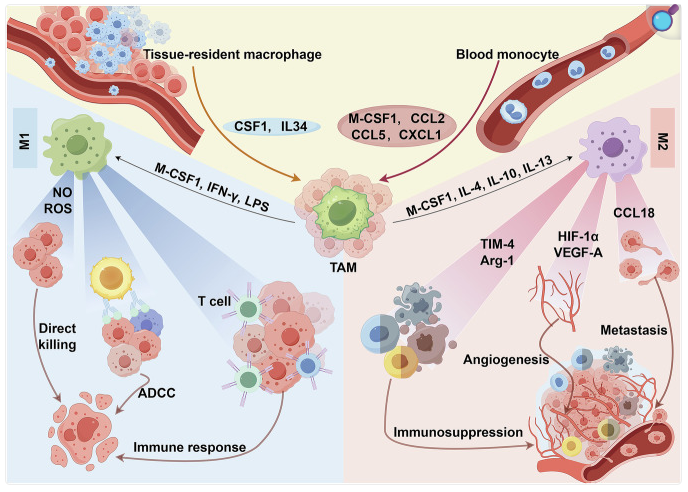
Distribution and density of tumor-associated macrophages in the tumor microenvironment.[Xu et al].
Key detection methods in this study: The core focus is on the quantitative detection of TAM polarization-related factors (TNF-α, IL-6, IL-10, TGF-β1, VEGF). ELISA technology has become a routine detection method in this field due to its high specificity and ease of operation. It is important to select high-sensitivity kits to capture changes in the expression of low-concentration factors in the tumor microenvironment.
Macrophages and Neurodegenerative Diseases: Functional Imbalance of the Brain's "Guardians"
Microglia (macrophages specialized in the central nervous system) are the brain's "immune sentinels." Under normal conditions, they clear abnormal proteins such as Aβ plaques (Alzheimer's disease AD) and α-synuclein (Parkinson's disease PD) from the brain, maintaining central nervous system homeostasis. When the body is in a pathological state, microglia are abnormally activated and polarized to the M1 type, secreting large amounts of pro-inflammatory factors such as TNF-α and IL-1β, triggering chronic neuroinflammation, exacerbating neuronal damage, and accelerating the progression of diseases such as AD and PD.
Key assays for this study: The study focuses on detecting pro-inflammatory factors associated with microglial activation (TNF-α, IL-1β, IL-6) and factors related to the clearance of abnormal proteins. Since the samples are mostly cerebrospinal fluid and brain tissue homogenates, ELISA assays require kits optimized for the sample matrix to avoid matrix interference and ensure assay specificity.
Macrophages and Metabolic Diseases: The "Invisible Culprits" of Metabolic Disorders
In metabolic diseases such as obesity, non-alcoholic steatohepatitis (NASH), and diabetes, abnormal infiltration and activation of macrophages are among the core pathogenic factors. In obese individuals, macrophages accumulate and activate in large numbers in adipose tissue, secreting pro-inflammatory factors such as IL-6 and TNF-α, triggering chronic inflammation in adipose tissue, which in turn leads to insulin resistance. In NASH, hepatic macrophages (Kupffer cells) are activated, promoting the progression of liver fibrosis.
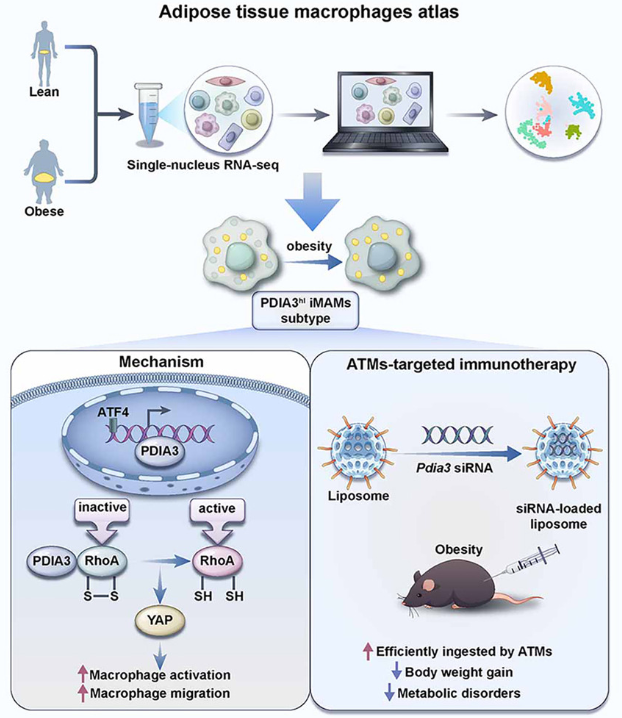
Nucleotide metabolic rewiring enables NLRP3 inflammasome hyperactivation in obesity [Liu DH, et.al].
Key assays for this study: The core assays detect macrophage-related pro-inflammatory factors (IL-6, TNF-α) and anti-inflammatory factors (IL-10) in adipose tissue and liver tissue. ELISA assays require compatible samples such as adipose tissue homogenate and liver homogenate. Furthermore, total protein quantification is recommended before ELISA assays, as this is a crucial step for reviewers to assess the reliability of ELISA data during the manuscript submission stage.
Commonality: Polarization imbalance is the core commonality.
Although the specific mechanisms of macrophage action vary across different diseases, they all revolve around "functional polarization imbalance"—abnormal switching between M1 and M2 polarization states disrupts immune balance, thereby driving disease progression. Therefore, accurate detection of macrophage polarization-related factors and identification of their polarization states are crucial for elucidating the mechanisms of macrophage action in diseases and are a fundamental basis for advancing research on the diagnosis and treatment of related diseases. Research on the association between macrophages and diseases is progressing towards precision and diversification; from mechanistic analysis to targeted intervention, each step relies on reliable detection technologies.
References
Xu,J.S. et al. Dual roles and therapeutic targeting of tumor-associated macrophages in tumor microenvironments. Signal Transduction and Targeted Therapy, 2025, 10: 268.
Liu DH, et.al. Nucleotide metabolic rewiring enables NLRP3 inflammasome hyperactivation in obesity. Science, 2026, 391(6782):eadq9006. doi: 10.1126/science.adq9006. Epub 2026 Jan 15.
Luo,J.H.et.al. PDIA3 defines a novel subset of adipose macrophages to exacerbate the development of obesity and metabolic disorders. Cell Metabolism, 2024, 36(10): 2262-2280.E5.
Yang,X.M. et.al. Microglial polarization in Alzheimer's disease: Mechanisms, implications, and therapeutic opportunities. J Alzheimers Dis. 2025 Mar;104(1):3-13. doi: 10.1177/13872877241313223
Tardito,S. et.al. Macrophage M1/M2 polarization and rheumatoid arthritis: A systematic review. Autoimmunity Reviews,2019,18(11).